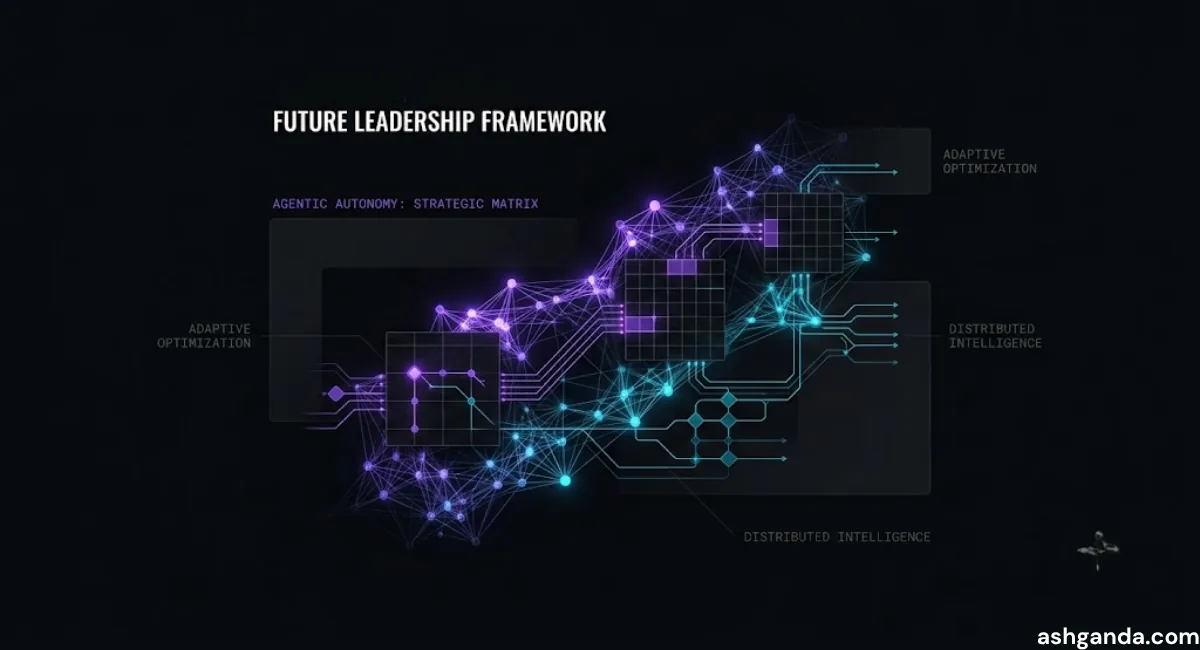
The Rise of Agentic AI: Why 2025 Is the Year of Autonomous AI Systems
While Everyone’s Debating Chatbots, Agentic AI Already Changed the Game
Here’s the uncomfortable truth most executives miss: the chatbot era is already over.
Not because GPT-4 or Claude isn’t impressive — they are. But because the next wave, agentic AI, makes prompt-response interactions look like a fax machine in a broadband world. Gartner projects that by 2028, agentic AI will autonomously resolve 15% of day-to-day work decisions without human intervention. McKinsey’s 2024 AI report puts the productivity uplift from agentic systems at 3–5× over standard generative AI for complex knowledge work.
This isn’t a tech trend. It’s a competitive restructuring. Companies that lock in agentic AI workflows in 2025 will build moats that are genuinely hard to replicate. The rest will spend 2026 and 2027 playing catch-up.
What Is Agentic AI — and Why the Distinction Matters
Most AI deployments today follow a simple loop: human asks, AI answers. Useful, but fundamentally limited by how much a human can prompt correctly and consistently.
Agentic AI breaks that loop. An AI agent perceives its environment, sets goals, plans multi-step actions, executes them using tools (APIs, browsers, code interpreters, databases), evaluates results, and iterates — without a human in the loop at every step.
Think about what that means operationally. A standard GPT integration might draft a contract clause when asked. An agentic system monitors a negotiation thread, identifies a clause that creates liability exposure, cross-references your legal playbook, drafts an amended clause, routes it to the right counterparty, and logs the interaction in your CRM — autonomously.
Key Enablers That Made 2025 the Inflection Point for Agentic AI
- Tool use maturity: OpenAI’s function calling, Anthropic’s tool use, and Google’s Gemini tool integrations reached production reliability in late 2024
- Long-context windows: 128k–1M token contexts let agents hold entire project states in memory
- Agent orchestration frameworks: LangGraph, AutoGen, Claude’s Agent SDK, and CrewAI moved from research projects to enterprise-grade frameworks
- Reduced hallucination rates: GPT-4o and Claude 3.5 Sonnet showed measurable reliability improvements that make autonomous action less risky
The Multi-Agent Architecture Advantage for Enterprise Agentic AI
Single agents are impressive. Multi-agent systems are transformative.
The best agentic AI deployments I’ve seen in 2024–2025 use a hierarchical structure: an orchestrator agent that decomposes complex tasks, specialist sub-agents that execute specific domains (research, code generation, data analysis, communication), and a review agent that validates outputs before they exit the system.
OpenAI’s internal deployment of multi-agent coding pipelines reportedly reduced code review cycles by 60%. Salesforce’s Agentforce, announced at Dreamforce 2024 and now in production, uses this exact architecture to handle complex sales workflows — lead qualification, email personalisation, CRM updates — with a claimed 35% improvement in sales team productivity.
Why Multi-Agent Systems Create Durable Competitive Moats
The strategic insight here is defensibility. Multi-agent systems create compounding advantages. Each agent improves through use. The orchestration logic encodes your business processes. Your data trains the context. After six months of operation, a competitor can’t replicate your agentic infrastructure by buying the same foundation models — because your competitive moat is in the integration, not the model.
Where Agentic AI Creates Immediate ROI in 2025
I’m not interested in theoretical upside. Here are the three areas where I’ve seen executive teams generate measurable returns in the first 90 days of agentic deployment:
1. Research and Competitive Intelligence
Manual competitive monitoring costs enterprise teams 10–20 hours per week across analysts. Agentic systems scan 50+ sources continuously, synthesise signals, flag anomalies, and push weekly briefings — with zero human involvement after setup. One financial services client reduced their market research operating cost by 70% within the first quarter.
2. Complex Workflow Automation Beyond RPA
Traditional RPA breaks when processes are even slightly variable. Agentic AI handles variability because it reasons, not just follows scripts. Legal document processing, financial reconciliation, technical support triage, procurement approval workflows — these are all live production use cases in 2025. The TAM for intelligent process automation is projected to hit $43B by 2027 (IDC, 2024).
3. Software Development Acceleration
GitHub Copilot was version 1.0. Agentic coding systems — Devin, Cursor’s agent mode, Anthropic’s Claude Code — are version 2.0. These systems write, test, debug, and refactor entire features with minimal human oversight. Early enterprise adopters report 40–60% reduction in time-to-production for standard feature work. That’s not productivity improvement. That’s business model disruption for anyone charging by developer hours.
The Risks Executives Underestimate With Agentic AI
Agentic AI creates new failure modes that boards need to understand before deployment. Three that I see consistently mismanaged:
Cascading Errors at Scale
An agent making a wrong decision doesn’t make it once — it makes it thousands of times before anyone notices. A poorly scoped research agent that misidentifies a key competitor will infect every downstream analysis. Audit trails and human-in-the-loop checkpoints at critical decision nodes aren’t optional — they’re architectural requirements.
Scope Creep by Design
Agentic systems, particularly those with broad tool access, will find efficient paths that humans never anticipated — including ones you didn’t authorise. Without explicit capability boundaries and least-privilege access controls, you’re not deploying an agent; you’re deploying a liability.
Vendor Lock-In at the Orchestration Layer
The foundation models are increasingly commoditised. The orchestration frameworks — how your agents communicate, remember, and coordinate — are not. Choosing LangGraph versus Microsoft’s AutoGen versus a proprietary vendor solution in 2025 is a 3–5 year architectural commitment. Evaluate carefully.
The Agentic AI Strategic Playbook for 2025
Executives who want to move fast without creating chaos should sequence their agentic AI investments as follows:
Phase 1 (Q1 2025): Identify two or three high-volume, well-defined internal workflows where errors are recoverable and the cost of manual work is measurable. Deploy contained, single-agent automations with clear success metrics.
Phase 2 (Q2–Q3 2025): Build internal capability — either a dedicated AI engineering team or a well-governed relationship with an AI implementation partner. The companies winning at agentic AI have internalised the orchestration knowledge. They don’t outsource the architecture.
Phase 3 (Q4 2025 and beyond): Deploy multi-agent systems at scale, with governance frameworks that include audit logging, performance dashboards, and human escalation paths. By this point, your data flywheel is generating competitive differentiation that’s genuinely hard to replicate.
The companies I’m watching most closely — across fintech, legaltech, and enterprise SaaS — all share one characteristic: they moved from AI experimentation to AI operationalisation in 2024. In 2025, they’re deploying agents. By 2026, those agents will be the business.
The Inflection Point Is Now
Agentic AI isn’t a 2027 problem. The companies treating it as a future consideration are already 12–18 months behind the leaders.
The shift from generative AI to agentic AI is the biggest architectural change in enterprise software since cloud computing. And just like cloud, the early movers will set the standards, capture the market share, and make it exponentially harder for laggards to catch up.
The question for every executive reading this isn’t whether to deploy agentic AI. It’s whether your organisation has the discipline to deploy it strategically, with the governance to realise the upside without inheriting the risk.
That discipline — not the technology itself — is the real competitive advantage in 2025.
Frequently Asked Questions About Agentic AI
What is agentic AI, and how is it different from regular AI chatbots?
Agentic AI refers to AI systems that autonomously perceive their environment, set goals, plan multi-step actions, and execute tasks using external tools — such as APIs, databases, and browsers — without requiring a human to prompt each step. Unlike traditional AI chatbots that respond to a single prompt and stop, agentic systems operate in continuous loops, evaluating their own outputs and iterating until a goal is achieved. The practical difference is that a chatbot drafts an email when asked; an agentic system monitors your inbox, identifies the right response, drafts and sends the email, updates your CRM, and flags any follow-up needed — all without human input at each step.
Why is 2025 considered the inflection point for agentic AI adoption?
Several converging factors made 2025 the tipping point. Tool use APIs from OpenAI, Anthropic, and Google reached production-grade reliability in late 2024. Long-context windows (up to 1M tokens) enabled agents to hold complex project state. Orchestration frameworks like LangGraph, AutoGen, and CrewAI matured from research prototypes to enterprise-ready infrastructure. Simultaneously, hallucination rates in leading models dropped enough to make autonomous execution less risky for business-critical workflows. The result: enterprise agentic AI moved from experimental to operational in a single year.
What are the biggest risks of deploying agentic AI in an enterprise?
The three most commonly underestimated risks are: (1) cascading errors — an agent acting on a flawed premise will repeat that mistake at scale before detection, so audit trails and human checkpoints are architectural necessities; (2) unauthorised scope expansion — agents with broad tool access will optimise for efficiency in ways that weren’t sanctioned, making least-privilege access controls critical; and (3) orchestration layer lock-in — the choice of agent framework (LangGraph, AutoGen, proprietary) is a multi-year architectural commitment, not a commodity decision.
How should an executive team get started with agentic AI in 2025?
Start with two to three high-volume internal workflows where errors are recoverable and manual costs are measurable — competitive research, document processing, and internal support triage are strong candidates. Deploy single-agent, contained automations with clear success metrics before scaling to multi-agent architectures. Critically, build internal orchestration knowledge rather than outsourcing it entirely; the competitive advantage in agentic AI lies in how you integrate the agents with your data and processes, not in the foundation models themselves.
For technical deep-dives on the cloud and IT topics I cover strategically, visit Cloud Geeks — our specialist IT infrastructure blog. Ganda Tech Services is my technology consultancy, bringing together cloud infrastructure, web development, and mobile expertise for Australian businesses.
AI Strategy Primer for Australian Business Leaders
A practical framework for AI adoption in 2026 — cut through the hype and start with what matters.