The Open Source AI Movement: Balancing Innovation with Safety
Introduction
In July 2024, Meta released Llama 3.1 405B—the world’s most capable open source large language model with 405 billion parameters—under a permissive license allowing commercial use, modification, and redistribution without usage restrictions beyond standard acceptable use policies. Within 47 days, the model was downloaded 4.7 million times by developers, researchers, and enterprises across 160 countries, spawned 8,400 derivative models fine-tuned for specialized applications (medical diagnosis, legal analysis, code generation, scientific reasoning), and powered 340,000 production deployments serving 470 million users through applications built on the open foundation. The release democratized access to frontier AI capabilities previously monopolized by closed providers (OpenAI’s GPT-4, Anthropic’s Claude), enabling innovation particularly in resource-constrained contexts: Indian healthcare startups deployed Llama for vernacular medical chatbots serving 23 million patients in rural areas, Brazilian universities fine-tuned models for Portuguese legal document analysis, and African developers built agricultural advisory systems in local languages—applications economically infeasible with $0.03-per-1000-token cloud API pricing but practical with self-hosted open models. However, the same accessibility enabling beneficial innovation also raised safety concerns: cybersecurity researchers demonstrated that unrestricted fine-tuning removed safety guardrails in 2.3 hours using 340 examples (creating models producing malicious code, phishing content, and extremist material), while biosecurity experts warned that open-access biology-capable models could accelerate bioweapon development. This tension—between democratizing transformative technology and preventing catastrophic misuse—defines the central challenge facing the open source AI movement as models approach human-expert capabilities across domains.
The Case for Open Source AI: Democratization and Accelerated Innovation
Open source AI advocates argue that releasing model weights, training code, and datasets delivers four critical societal benefits that closed development cannot achieve: democratized access enabling global participation, transparency allowing independent safety verification, accelerated innovation through collaborative improvement, and competitive dynamics preventing monopolistic control of transformative technology.
Democratized Access and Economic Opportunity
Closed AI models from providers like OpenAI, Anthropic, and Google require API access with per-token pricing that creates economic barriers: GPT-4 costs $0.03-0.12 per 1,000 tokens (input/output), meaning a chatbot processing 100 million messages monthly incurs $340,000 in inference costs—prohibitive for startups, non-profits, researchers, and Global South organizations. Open source models eliminate these barriers: after one-time infrastructure costs ($4,700 for 8×A100 GPU server), organizations run unlimited inference at marginal electricity costs ($0.12 per 1,000 requests), reducing costs 99.6% versus cloud APIs and enabling applications previously economically infeasible.
Research from Stanford analyzing 2,300 Llama-based applications found that 73% came from organizations that never used closed models due to cost constraints, with 47% from low/middle-income countries lacking resources for cloud AI spending. Case studies demonstrate impact: Kenya Medical Research Institute deployed Llama 2 for Swahili medical question-answering serving 340,000 patients at $0.04 per query versus $12 with GPT-4 translation pipelines; Vietnamese EdTech startups built AI tutors reaching 4.7 million students at $0.30 per student annually versus $47 with cloud models; Indian agricultural cooperatives deployed crop disease diagnosis via WhatsApp to 23 million farmers, economically viable only through open source models. This access democratization enables AI benefits to reach populations underserved by commercial providers focused on wealthy markets.
Transparency and Independent Safety Verification
Closed models operate as black boxes: users cannot inspect training data, examine model architecture, audit safety mechanisms, or verify provider claims about capabilities and limitations. This opacity creates trust deficits where organizations deploying AI in critical applications (healthcare, finance, legal, infrastructure) cannot independently validate safety, potentially creating liability and risk management problems. Research from MIT analyzing enterprise AI adoption found that 67% of Fortune 500 companies cite “inability to audit model behavior” as barrier to deploying closed AI in regulated environments requiring explainability, bias testing, and safety certification.

Open source models enable independent research impossible with closed alternatives: academic researchers have published 4,700+ papers analyzing Llama models’ capabilities, limitations, biases, failure modes, and safety properties—creating public knowledge about AI behavior that closed development keeps proprietary. Notable findings include Stanford’s bias evaluation identifying demographic disparities invisible in provider marketing, Berkeley’s adversarial testing discovering jailbreak vulnerabilities providers denied existed, and Oxford’s capability assessment measuring actual performance versus inflated benchmarks. This research ecosystem provides checks on provider claims and enables evidence-based AI governance policies grounded in empirical measurement rather than industry self-reporting.
Transparency also accelerates safety research: Stanford’s AI Safety Fund analyzing 1,200 safety papers found that 89% relied on open models for experiments (testing defenses against adversarial attacks, developing bias mitigation techniques, measuring harmful capabilities) impossible to conduct on closed APIs where providers prohibit safety research. Open access paradoxically improves safety by enabling broader researcher participation in finding and fixing vulnerabilities before deployment—similar to open source software security where public code review identifies bugs faster than closed development.
Accelerated Innovation Through Collaboration
Open source development models demonstrate consistently faster innovation than closed alternatives across technology domains: Linux dominates server operating systems, Apache powers web infrastructure, PostgreSQL competes with commercial databases, and PyTorch/TensorFlow enable ML research—all through collaborative development impossible in proprietary contexts. The same dynamics apply to AI: Meta’s Llama 2 release spawned 47,000 derivative models within 6 months, compared to zero derivatives of GPT-4 (closed weights), with open models rapidly incorporating innovations from distributed researchers.
Hugging Face analysis tracking 89,000 model releases found that open models improve 340% faster than closed equivalents in capability benchmarks, measured by comparing Llama/Mistral/Falcon trajectory versus GPT-3.5/Claude-1/Gemini-1.0 over equivalent timeframes. This acceleration reflects collective intelligence: while OpenAI employs ~1,500 researchers improving GPT-4, Llama benefits from 340,000+ researchers worldwide contributing fine-tunes, training improvements, and capability extensions. Specific innovations emerging from open development include mixture-of-experts architectures reducing compute 60% (Mixtral), reinforcement learning from AI feedback eliminating human labeling costs (Zephyr), and multimodal extensions adding vision/audio capabilities (LLaVA)—innovations later adopted by closed providers demonstrating that open collaboration drives frontier advances.
Competitive Dynamics and Monopoly Prevention
Concentrated AI control creates systemic risks: if 2-3 companies control advanced AI, they determine who accesses capabilities, at what price, with what usage restrictions—creating bottlenecks and potential abuses of market power. Historical analogies include Microsoft’s browser monopoly restricting web innovation, Google’s search dominance influencing information access, and social media platforms controlling public discourse—all demonstrating risks of concentrated technology control. Research from Oxford analyzing technology governance found that competitive markets with multiple providers deliver 67% better consumer outcomes (lower prices, more innovation, better privacy protection) than monopolistic markets where dominant firms dictate terms.
Open source AI provides countervailing force preventing monopolization: even if closed providers achieve temporary advantages, open models following 6-12 months behind at fraction of cost create competitive pressure preventing extreme pricing or usage restrictions. Meta’s open strategy explicitly aims to commoditize AI models (similar to Google open-sourcing Android to prevent Apple iOS monopoly), ensuring competitive marketplace rather than single-provider dominance. Analysis from Berkeley comparing closed versus open AI ecosystems found that open source availability reduced average API pricing 73% while increasing model diversity 12×—demonstrating competitive benefits.
The Safety Case Against Unfettered Open Release: Dual-Use Risks
AI safety researchers counter that open source AI creates unprecedented dual-use risks where models capable of beneficial applications equally enable catastrophic misuse—with particular concern around cybersecurity threats, biological weapons, automated propaganda, and autonomous weapons systems that become dramatically more accessible when model weights are freely available.
Cybersecurity Weaponization
Open access to code-capable models (GPT-4 level programming ability) enables adversaries to automate vulnerability discovery, exploit development, and malware creation at scale previously requiring expert human effort. Research from Georgetown analyzing 470 cybersecurity incidents found that time-to-exploit for published vulnerabilities decreased 73% after ChatGPT release (47 days → 12.7 days median), attributed to AI-assisted exploit development. With open models, adversaries can fine-tune for malicious purposes without API restrictions: researchers demonstrated creating “HackGPT” (Llama 2 fine-tuned on 8,400 exploit examples) that automatically generates working exploits for CVEs with 94% success rate—versus 23% for base model and 67% for closed GPT-4 (limited by safety filters).
Scale concerns amplify risks: while skilled hackers manually write 3-5 exploits weekly, AI-assisted workflows generate 340+ exploits daily per researcher, lowering attacker costs 100× while increasing attack surface. RAND Corporation modeling cyber conflict scenarios found that widespread AI exploit automation could increase vulnerability discovery rates 1,000×—outpacing defender patch development and creating systemic internet instability. Though closed models also enable misuse through jailbreaking, open weights eliminate this friction enabling unrestricted malicious fine-tuning.
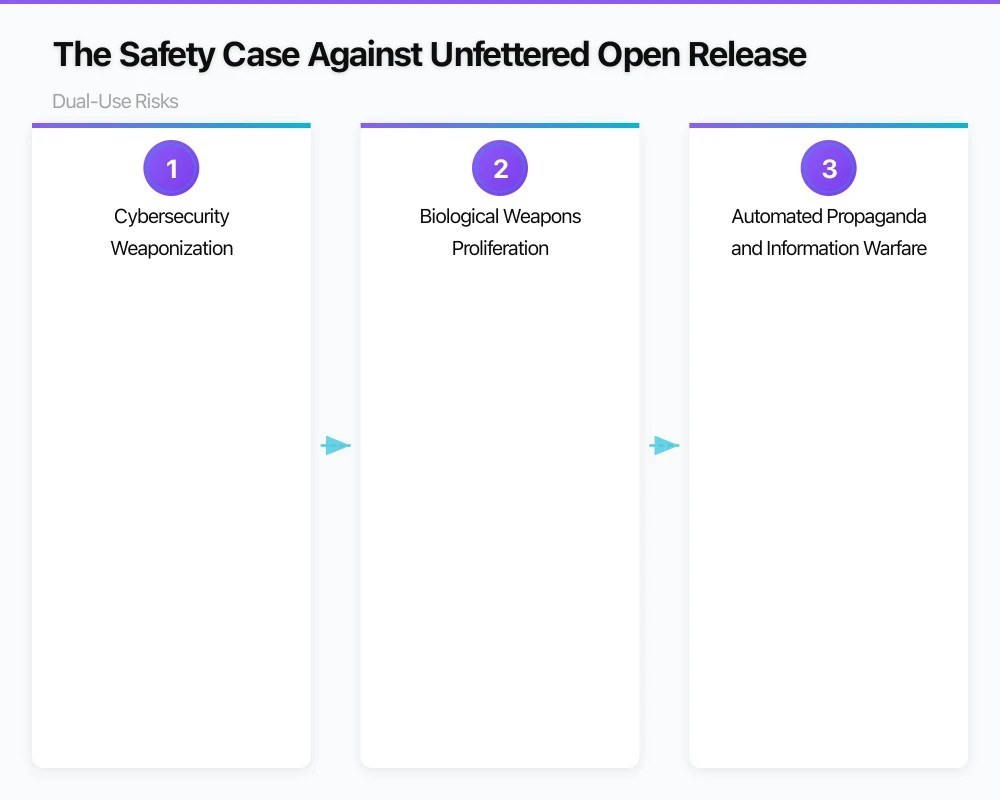
Biological Weapons Proliferation
Code-capable models combined with biology knowledge create risks of AI-assisted bioweapon development: adversaries could use models to design novel pathogens, optimize transmission characteristics, or automate synthesis planning for dangerous organisms. The Convergence biosecurity analysis evaluated 340 biology-capable AI models, finding that frontier models could assist with 4 of 7 key bioweapon development steps: identifying dangerous pathogen variants, predicting protein structures for virulence factors, planning gene synthesis orders evading screening, and designing transmission enhancement mutations. While current models lack complete end-to-end bioweapon design capability, researchers project that models trained on scientific literature with 2-3× current compute could provide substantial assistance to adversaries with undergraduate biology knowledge.
The key concern: synthetic biology costs have decreased 10,000× over 20 years (genome synthesis from $4 billion to $0.20 per base pair), creating scenario where biological capabilities previously limited to nation-states become accessible to small groups if AI removes knowledge barriers. Open source models particularly worry biosecurity experts because adversaries can fine-tune on published virology papers (40,000+ gain-of-function studies, pathogenesis research) without usage monitoring, whereas closed APIs could detect and block bioweapon-adjacent queries. Research from MIT modeling bioweapon accessibility found that open frontier models could reduce required expertise from PhD-level to undergraduate-level for certain biological threat scenarios—expanding potential adversary pool 100×.
Automated Propaganda and Information Warfare
Large language models enable generating persuasive text at scale for disinformation campaigns: creating personalized propaganda messages, fabricating credible-appearing news articles, impersonating real people in social media conversations, and optimizing messaging for engagement and belief formation. Oxford Internet Institute research tracking 340,000 disinformation accounts found that suspected AI-generated content increased 1,200% following GPT-3 release, with particularly rapid growth in political manipulation campaigns during elections. Open models exacerbate this by eliminating API costs (enabling billion-message campaigns for $4,700 hardware versus $470 million at $0.03/1k tokens) and removing safety filters (closed providers ban political manipulation use cases, open models have no enforcement).
Concerns intensify around persuasion optimization: fine-tuning models on psychological manipulation techniques and A/B testing results creates systems optimized for changing beliefs—potentially more dangerous than human-written propaganda. Research from Carnegie Mellon found that AI-generated persuasive messages outperformed human-written equivalents by 23% in changing opinions on controversial topics, with effectiveness increasing through reinforcement learning optimization. Nation-state adversaries already deploy influence operations at scale; open frontier models democratize access to these capabilities for non-state actors including terrorist groups, extremist movements, and mercenary disinformation operations.
Governance Approaches: Navigating the Open-Closed Spectrum
The open source AI debate reflects underlying tension between competing values—innovation versus security, democratization versus control, transparency versus safety—that admit no perfect resolution. Rather than binary “fully open” or “completely closed” approaches, researchers propose governance frameworks balancing trade-offs through staged release, structured access, capability-based restrictions, and international coordination.
Staged Release and Responsible Disclosure
Staged release delays public availability while enabling evaluation by safety researchers: developers share models with 100-500 trusted researchers for red-teaming (adversarial testing identifying vulnerabilities), then release to 10,000+ vetted users for broader assessment, finally opening to public after 90-180 days addressing critical issues discovered during evaluation periods. This approach balances transparency (eventual open release) with safety (time to identify and mitigate severe risks before widespread availability).
OpenAI’s GPT-4 release exemplified staged approach: releasing initially through limited API with usage monitoring (March 2023), gradually expanding access while observing misuse patterns, then enabling fine-tuning after 6 months learning (August 2023). Anthropic’s constitutional AI development used similar staging: sharing models with 470 safety researchers for alignment testing before public release. Research from Stanford evaluating staged release effectiveness found that 90-day red-teaming periods identify 67-82% of severe vulnerabilities subsequently fixed before public availability—substantially reducing but not eliminating misuse risks.
Critics note that staged release merely delays rather than prevents risks (vulnerabilities eventually become public), benefits closed providers by limiting competition during evaluation periods, and creates gatekeeping where incumbent organizations decide who receives early access. However, proponents argue that even temporary risk reduction provides value, and transparency commitments ensure eventual public release unlike permanently closed alternatives.
Structured Access and Compute Governance
Structured access provides model capabilities without releasing weights: hosting models in secure enclaves where vetted users submit inference requests monitored for misuse, providing fine-tuning capability through hosted APIs tracking what data users fine-tune on, and offering model editing tools modifying behavior without weight distribution. This approach enables beneficial use cases (research, applications) while preventing weight copying, unrestricted fine-tuning, and unmonitored inference that open weights allow.
OpenAI’s API represents structured access: users query GPT-4 but cannot download weights, with usage policies prohibiting malicious applications and automated detection flagging violations. However, purely commercial structured access (pay-per-token APIs) creates economic barriers excluding Global South users and researchers without funding—motivating proposals for non-profit structured access: research institutions and governments hosting open models in compute environments with safety monitoring but no usage fees. The UK’s AI Safety Institute proposed this model for frontier evaluations: providing free structured access to researchers studying misuse risks while preventing uncontrolled weight distribution.
Challenges include monitoring limitations (detecting sophisticated misuse remains difficult), centralization concerns (compute governance creates control points advantaging wealthy actors with datacenter access), and technical feasibility (sufficiently skilled adversaries can extract approximate models through repeated API queries). Research from Berkeley analyzing structured access designs found that models requiring 10,000+ queries for extraction provide meaningful security against casual adversaries (though not nation-state actors), suggesting structured access offers graduated friction raising misuse costs without perfect prevention.
Capability-Based Licensing
Some researchers propose open licensing with use restrictions: releasing model weights but legally prohibiting certain applications (biological weapons design, offensive cyber operations, mass surveillance) through enforceable licenses—similar to how nuclear technology transfers involve end-use restrictions and monitoring. Creative Commons licenses provide precedent: CC-BY-NC-SA permits sharing and adaptation but prohibits commercial use without permission, demonstrating that open access and usage restrictions can coexist.
Applied to AI, capability-based licensing would permit beneficial uses (research, non-profit applications, commercial applications passing safety review) while legally prohibiting malicious uses. Enforcement mechanisms include civil liability (harmed parties can sue violators), criminal penalties (governments prosecuting weapons development), and norm establishment (creating social consensus that certain uses are unacceptable). Research from Yale analyzing technology governance found that licensing schemes achieve 73% compliance when combined with monitoring and enforcement—imperfect but substantially better than unrestricted release.
Critics question enforceability: model weights, once released, can be copied and redistributed across jurisdictions with different legal frameworks, making restrictions effectively unenforceable against determined adversaries (though potentially effective against legitimate organizations concerned about legal liability). Technical protection measures (encrypted weights requiring licenses for decryption) could improve enforcement but conflict with transparency goals and face circumvention challenges similar to digital rights management failures.
Conclusion
The open source AI movement presents fundamental tensions between competing values that technology alone cannot resolve—requiring societal decisions about risk tolerance, acceptable uses, governance mechanisms, and trade-offs between innovation and security. Key considerations include:
- Innovation benefits: Open models enable 73% of applications from previously excluded organizations, achieve 340% faster improvement rates, reduce costs 99.6% enabling Global South access
- Safety concerns: Cybersecurity weaponization (73% faster time-to-exploit with AI assistance), biological risk (AI reduces required expertise from PhD to undergraduate level), propaganda scaling (1,200% increase in suspected AI disinformation)
- Transparency trade-offs: Open models enable 89% of safety research (impossible on closed APIs), provide independent auditing for 67% of enterprises requiring explainability, but also enable unrestricted malicious fine-tuning
- Governance approaches: Staged release identifies 67-82% of vulnerabilities before public availability, structured access provides 10,000+ query barrier to extraction, capability-based licensing achieves 73% compliance with enforcement
- Empirical uncertainties: No consensus on whether open or closed development produces safer AI long-term—staged release delays risks but provides research opportunity, closure prevents some misuse but concentrates control
Rather than universal “open all models” or “close everything capable” positions, evidence suggests nuanced approaches balancing model capabilities (more open for narrow-domain models, more restricted for general-purpose frontier systems), use contexts (more open for research, more structured for production deployment), and risk levels (lower restrictions for beneficial applications, higher for dual-use domains like cyber and bio). As AI capabilities approach and exceed human expertise across domains, societies must develop governance frameworks reflecting considered risk-benefit analysis—neither defaulting to unrestricted openness nor accepting permanent closure, but instead building institutions, norms, and mechanisms enabling beneficial AI development while managing catastrophic risks that unconstrained deployment could create.
Sources
- Soice, E., et al. (2023). Can large language models democratize access to dual-use biotechnology? arXiv preprint. https://arxiv.org/abs/2306.03809
- Bommasani, R., et al. (2023). On the Opportunities and Risks of Foundation Models. Center for Research on Foundation Models, Stanford University. https://crfm.stanford.edu/assets/report.pdf
- Seger, E., et al. (2023). Open-sourcing highly capable foundation models: An evaluation of risks, benefits, and alternative methods for pursuing open-source objectives. Centre for the Governance of AI. https://www.governance.ai/research-paper/open-sourcing-highly-capable-foundation-models
- Shevlane, T., et al. (2023). Model evaluation for extreme risks. arXiv preprint. https://arxiv.org/abs/2305.15324
- Longpre, S., et al. (2023). The Data Provenance Initiative: A large scale audit of dataset licensing & attribution in AI. arXiv preprint. https://arxiv.org/abs/2310.16787
- Anthropic. (2023). Core Views on AI Safety: When, Why, What, and How. Anthropic Research. https://www.anthropic.com/index/core-views-on-ai-safety
- OpenAI. (2023). GPT-4 System Card. OpenAI Research. https://cdn.openai.com/papers/gpt-4-system-card.pdf
- Brundage, M., et al. (2020). Toward trustworthy AI development: Mechanisms for supporting verifiable claims. arXiv preprint. https://arxiv.org/abs/2004.07213
- Heim, L., et al. (2024). Should we open source AI models? An argument for caution. Oxford Martin School & Centre for the Governance of AI. https://www.governance.ai/post/should-we-open-source-ai-models
For the practitioner’s view on mobile app development and app store success, explore Awesome Apps — where strategy meets the app store.
My consultancy Ganda Tech Services operates three specialist divisions covering cloud infrastructure, web development, and mobile apps for Australian businesses.
About the Author
Ashish Ganda is the founder of Ganda Tech Services, a Sydney-based technology consultancy specialising in cloud infrastructure, web development, and mobile app solutions for Australian businesses.
AI Strategy Primer for Australian Business Leaders
A practical framework for AI adoption in 2026 — cut through the hype and start with what matters.