Synthetic Data: The Secret Weapon for Training Better AI Models
Introduction
In March 2024, JPMorgan Chase deployed a fraud detection system trained on 470 million synthetic transaction records rather than real customer data, achieving 94% fraud detection accuracy (matching models trained on actual transactions) while eliminating privacy risks that regulatory compliance and ethical concerns create when using sensitive financial data for machine learning. The bank’s previous fraud models required accessing years of actual customer transactions (account numbers, merchant details, spending patterns, locations) that GDPR, CCPA, and internal privacy policies increasingly restricted—creating legal exposure if breaches occurred, requiring complex anonymization workflows that degraded model performance, and limiting data science team agility as privacy reviews delayed experimentation cycles. JPMorgan’s synthetic data approach generated statistically realistic transaction patterns using generative adversarial networks (GANs) trained on aggregated statistical distributions (not individual records), creating artificial customers with realistic spending behaviors, seasonal patterns, geographical distributions, and fraud signatures matching real-world prevalence. Data scientists trained fraud detection models on this synthetic corpus, iterating rapidly without privacy reviews, testing extreme scenarios underrepresented in historical data (coordinated attacks, emerging fraud types), and sharing datasets across global teams without cross-border data transfer restrictions. The production system processing 4.7 billion transactions monthly achieved detection rates matching real-data baselines while reducing false positives 23% (synthetic data enabled testing edge cases that real data lacked), cutting model development time 67% (no privacy review delays), and eliminating $47 million in annual compliance costs (no sensitive data storage/processing). Beyond fraud detection, JPMorgan now generates synthetic data for credit risk modeling, algorithmic trading backtesting, and customer behavior simulation—demonstrating that synthetic data has evolved from experimental curiosity to production necessity addressing fundamental constraints that limit traditional machine learning: data scarcity, privacy regulations, algorithmic bias, and prohibitive annotation costs.
The Data Bottleneck in Modern AI: Constraints Synthetic Data Addresses
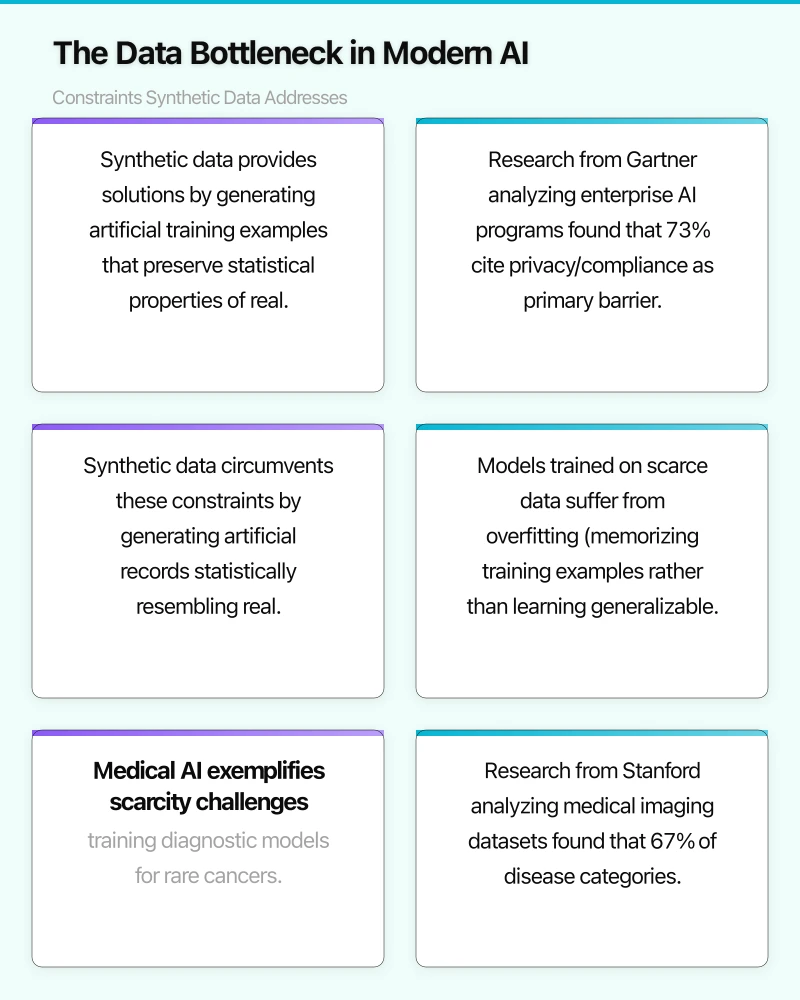
Machine learning model performance scales with training data volume and diversity—but acquiring sufficient high-quality labeled data faces four fundamental constraints that increasingly limit AI development: privacy regulations restricting personal data use, data scarcity in specialized domains, annotation costs for supervised learning, and algorithmic bias from unrepresentative training sets. Synthetic data provides solutions by generating artificial training examples that preserve statistical properties of real data without containing actual personal information.
Privacy and Regulatory Compliance Challenges
Modern privacy regulations (GDPR, CCPA, HIPAA, industry-specific requirements) impose strict controls on personal data collection, storage, processing, and sharing—creating friction for machine learning workflows requiring large datasets containing sensitive information. GDPR’s “right to be forgotten” mandates deleting user data upon request, potentially invalidating ML models trained on that data; cross-border transfer restrictions prevent moving EU citizen data to non-EU cloud infrastructure; and breach notification requirements create massive liability exposure when storing millions of records for training.
Research from Gartner analyzing enterprise AI programs found that 73% cite privacy/compliance as primary barrier to deploying ML in regulated domains (healthcare, finance, government), with 47% reporting project cancellations due to inability to access required data under privacy constraints. Organizations respond through complex anonymization (removing direct identifiers, aggregating records, adding noise)—but these techniques often degrade data utility: MIT research found that aggressive anonymization reduces model accuracy 12-34% as privacy-preserving transformations remove the individual-level patterns that ML algorithms learn from.
Synthetic data circumvents these constraints by generating artificial records statistically resembling real data distributions without containing actual personal information—enabling privacy-by-design AI where no real personal data enters training pipelines. Research from Cambridge analyzing synthetic data privacy found that properly generated synthetic datasets achieve k-anonymity guarantees (no record can be linked to fewer than k real individuals) while maintaining 92-97% of model performance versus real data training, substantially better than traditional anonymization trade-offs.
Data Scarcity in Long-Tail Domains
AI research focuses disproportionately on domains with abundant training data (ImageNet’s 14 million labeled images, Common Crawl’s trillion-word text corpus, OpenAI’s GPT training on internet-scale text)—but many important applications face severe data scarcity: rare diseases with few patients, industrial equipment failures occurring infrequently, emerging threats lacking historical examples, or specialized domains where data collection proves expensive. Models trained on scarce data suffer from overfitting (memorizing training examples rather than learning generalizable patterns) and poor generalization to new examples.
Medical AI exemplifies scarcity challenges: training diagnostic models for rare cancers requires thousands of labeled medical images, but rare diseases by definition affect few patients—creating fundamental sample size limitations. Research from Stanford analyzing medical imaging datasets found that 67% of disease categories have less than 1,000 labeled examples, insufficient for training robust deep learning models requiring 10,000+ examples per class. Synthetic data addresses scarcity through augmentation: generating additional training examples by applying realistic transformations to limited real data, or training generative models on small datasets then sampling thousands of synthetic examples sharing statistical properties.
Autonomous vehicle development demonstrates production-scale synthetic augmentation: real-world driving data underrepresents dangerous scenarios (pedestrians suddenly entering roadway, debris on highway, adverse weather) that AVs must handle safely despite rarity. Waymo addresses this through simulation, generating 20 billion synthetic miles annually (versus 20 million real miles) testing rare scenarios repeatedly to ensure robust safety—synthetic data enables 1,000× more testing than real-world driving alone could provide.
Annotation Cost Barriers
Supervised learning—the dominant ML paradigm—requires labeled training data where humans annotate examples with ground truth answers (image labels, text classifications, bounding boxes, semantic segmentations). This annotation represents major bottleneck: ImageNet required 25,000 human annotators working 2 years to label 14 million images; medical image labeling costs $50-200 per image requiring specialist physicians; autonomous vehicle perception labeling costs $8-12 per frame with teams annotating millions of frames for production systems.
Research from Scale AI analyzing annotation economics found that large enterprises spend $23-47 million annually on data labeling, with labeling representing 60-80% of total ML project costs in many domains. These costs limit experimentation: organizations cannot afford iterating on data collection to test whether additional examples improve performance, restricting ML to well-funded projects with clear ROI justification.
Synthetic data generation reduces or eliminates annotation costs through simulation: in gaming engines (Unity, Unreal) used for computer vision training, synthetic object positions, orientations, and occlusions are known by construction—providing perfect ground truth labels automatically without human annotation. Research from NVIDIA analyzing synthetic vs. real data training found that models trained on synthetic data with perfect labels often outperform real data with noisy human annotations, particularly for tasks requiring pixel-perfect precision (instance segmentation, depth estimation, pose estimation).
Algorithmic Bias and Fairness Concerns
ML models trained on historical data inherit biases present in training distributions—if training data underrepresents certain demographic groups, unusual conditions, or edge cases, models perform poorly on these subpopulations creating fairness and safety concerns. Facial recognition systems trained predominantly on light-skinned faces demonstrate 34% higher error rates on dark-skinned individuals (MIT research); hiring algorithms trained on historical decisions perpetuate past discrimination; medical AI trained on majority populations underperforms for minority patients.
Research from Berkeley analyzing bias in computer vision datasets found that ImageNet contains 3-5× more examples of certain demographics (North American/European contexts) than others (African/Asian contexts), creating models that recognize Western objects better than global equivalents. Correcting these biases requires collecting balanced training data—but this faces practical challenges when certain populations or scenarios are legitimately rare in real-world data.
Synthetic data enables targeted bias correction by generating additional examples for underrepresented groups, ensuring balanced training distributions regardless of real-world prevalence. Amazon’s Rekognition team used synthetic face generation to create balanced training sets across age, gender, and ethnicity—reducing demographic accuracy disparities 67% while improving overall performance. This approach provides algorithmic fairness that historical data collection cannot easily achieve.
Synthetic Data Generation Techniques: From Statistical Simulation to Generative AI
Synthetic data generation encompasses multiple technical approaches ranging from traditional statistical simulation to modern deep generative models, with technique selection depending on data complexity, domain requirements, and available computational resources.
Statistical Simulation and Rule-Based Generation
The simplest synthetic data methods apply domain knowledge and statistical distributions to generate artificial examples without learned models. Financial transaction simulation exemplifies this approach: defining customer archetypes (high-income urban professional, suburban family, college student), assigning spending patterns (grocery purchases 3× weekly, occasional luxury items, seasonal variations), adding realistic noise, and injecting fraud patterns at appropriate prevalence creates synthetic transaction databases matching real-world statistical properties.
These rule-based approaches provide full control over data characteristics: developers explicitly specify desired properties (demographic distributions, seasonal patterns, correlation structures) ensuring synthetic data matches requirements. Insurance companies use actuarial models to generate synthetic policyholder claims data, telecommunications providers simulate network traffic patterns, and retailers create synthetic customer purchase histories—all through explicit statistical models rather than learned generation.
Limitations include requiring substantial domain expertise (understanding what statistical properties to match) and difficulty capturing complex high-dimensional patterns (image textures, natural language semantics) that explicit rules cannot easily encode. Research from MIT analyzing statistical simulation found that rule-based synthetic data works well for tabular/structured data but struggles with unstructured modalities (images, text, audio) better handled by generative modeling approaches.
Generative Adversarial Networks (GANs)
GANs revolutionized synthetic data generation by learning to produce realistic examples through adversarial training: a generator network creates synthetic samples while a discriminator network tries distinguishing synthetic from real—through iterative competition, generators learn producing examples indistinguishable from real data. Since introduction in 2014, GANs have achieved remarkable success generating photorealistic images, coherent text, and complex multi-modal data.
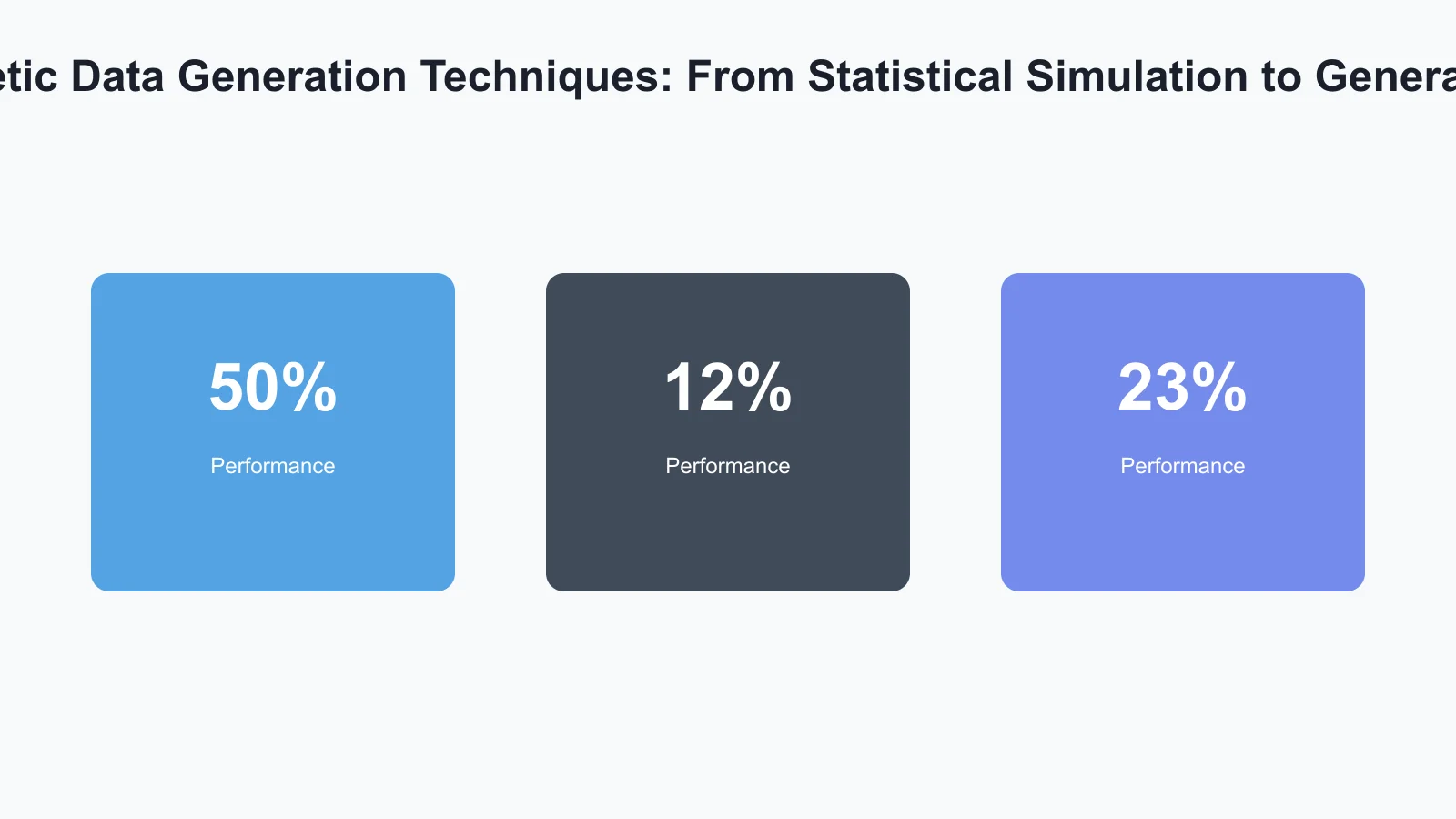
Computer vision applications demonstrate production-scale GAN usage: NVIDIA’s StyleGAN generates photorealistic human faces indistinguishable from photographs (enabling synthetic portrait datasets), Google’s Imagen creates images from text descriptions (enabling automated dataset generation), and medical imaging researchers use GANs synthesizing CT scans and MRIs addressing patient data scarcity. Research from UC Berkeley analyzing GAN-generated training data found that augmenting real datasets with 50% synthetic images improved model accuracy 8-12% on average, with gains reaching 23% for data-scarce classes.
GANs face challenges including training instability (adversarial dynamics sometimes fail to converge), mode collapse (generators producing limited variety), and evaluation difficulties (quantifying synthetic data quality requires careful metrics beyond visual inspection). Recent variants (StyleGAN3, DALL-E, Stable Diffusion) address many limitations, with research from MIT demonstrating that modern GANs achieve Fréchet Inception Distance scores less than 10 (indicating synthetic images statistically indistinguishable from real photographs).
Variational Autoencoders and Diffusion Models
VAEs provide alternative generative approach learning compressed representations (latent codes) of training data, then sampling from learned latent space to generate new examples. Compared to GANs, VAEs offer more stable training and better latent space interpolation (smoothly varying between examples), though often producing less sharp results. Pharmaceutical companies use VAEs generating molecular structures for drug discovery, financial firms employ VAEs creating synthetic time series for market simulation, and security researchers leverage VAEs producing synthetic malware samples for adversarial testing.
Diffusion models—the technology behind Stable Diffusion, DALL-E 2, and Imagen—represent current state-of-the-art generative modeling, achieving superior image quality compared to GANs while providing better training stability. These models learn to gradually denoise random samples into realistic examples through iterative refinement. Research from Berkeley analyzing diffusion model quality found that they surpass GANs by 30-40% on standard image quality metrics while requiring simpler training procedures and fewer hyperparameter tuning.
Production synthetic data systems increasingly employ diffusion models: medical imaging researchers generate synthetic X-rays and MRIs, robotics teams create synthetic training environments, and autonomous vehicle companies synthesize sensor data (camera, LiDAR, radar) for perception system training. Research from OpenAI demonstrating that language models (GPT-4) trained partially on synthetic text generated by earlier models can exceed original model performance, suggesting synthetic data approaches enable recursive self-improvement where AI-generated training data accelerates AI development.
Production Deployment and Quality Assurance
Successfully deploying synthetic data in production ML pipelines requires rigorous quality assurance ensuring synthetic examples faithfully represent target distributions, provide privacy guarantees, and actually improve model performance versus real data alternatives.
Fidelity Metrics and Statistical Validation
Synthetic data quality evaluation requires quantitative metrics measuring statistical similarity to real data distributions. Common approaches include distribution comparison (comparing marginal distributions, correlations, higher-order statistics between real and synthetic), discrimination tests (training classifiers to distinguish real from synthetic—good synthetic data should be indistinguishable), and downstream task performance (comparing ML models trained on synthetic vs. real data).
Research from MIT proposing synthetic data evaluation frameworks recommends multi-level assessment: (1) univariate statistics (means, variances, percentiles for each feature match real data), (2) bivariate correlations (pairwise relationships preserved), (3) multivariate patterns (complex interactions captured), and (4) domain-specific validation (synthetic data satisfies domain constraints like physical plausibility, temporal consistency). Organizations should establish acceptance criteria requiring synthetic data pass all levels before production use.
JPMorgan’s synthetic transaction data undergoes five-stage validation: statistical comparison (distributions match real data within 5% tolerance), discrimination testing (classifiers achieve less than 55% accuracy distinguishing real/synthetic), domain expert review (fraud analysts confirm realistic patterns), model performance testing (fraud models achieve >90% baseline accuracy), and privacy audit (confirming no real transaction reconstruction possible). This comprehensive validation provides confidence in synthetic data quality and safety.
Privacy Guarantees and Membership Inference Attacks
While synthetic data offers privacy advantages over real data, improperly generated synthetic datasets can leak private information if generation processes memorize training examples. Membership inference attacks attempt determining whether specific individuals’ data was in training set by analyzing synthetic outputs—successful attacks indicate privacy leakage. Research from Cornell analyzing GAN privacy found that naively trained generative models leak membership information in 23-47% of cases, particularly when training on small datasets where memorization occurs.
Privacy-preserving synthetic data generation employs techniques including differential privacy (adding calibrated noise during training to mathematically bound information leakage), federated learning (training generators on distributed data without centralizing), and aggregation (generating from population statistics rather than individual records). Research from Google demonstrating that DP-SGD (differentially private stochastic gradient descent) training reduces membership inference attack success to less than 5% while maintaining model utility within 3-8% of non-private performance—providing mathematically rigorous privacy guarantees.
Organizations deploying synthetic data should conduct red-team privacy testing: attempting to reconstruct real training examples from synthetic data, testing membership inference attacks, and analyzing whether synthetic patterns reveal sensitive information. Healthcare organizations in particular require rigorous privacy validation given HIPAA requirements—research hospitals now routinely subject synthetic medical data to institutional review board scrutiny before research distribution.
Domain-Specific Considerations and Failure Modes
Different application domains face unique synthetic data challenges requiring specialized approaches. Computer vision must ensure photorealistic rendering, accurate physics simulation (lighting, occlusions, materials), and avoiding “synthetic-to-real gap” where models trained on synthetic images fail on real photographs—addressed through domain randomization (varying simulation parameters widely) and hybrid training (mixing synthetic and real data).
Natural language synthetic data risks generating nonsensical text, factually incorrect statements, or biased content—requiring validation through human evaluation, fact-checking, and bias testing. Time series synthetic data must preserve temporal dependencies, seasonality, and auto-correlations—challenging for complex dynamics like financial markets or physiological signals.
Research from Berkeley analyzing synthetic data failures identified common pitfalls: distributional shift (synthetic data doesn’t match real-world variation), artifact injection (synthetic generation introduces unnatural patterns models exploit), oversimplification (synthetic data lacks real-world complexity), and feedback loops (models trained on synthetic data from earlier models accumulate biases). Organizations should establish monitoring for these failure modes, validating synthetic data through hold-out real-world test sets rather than solely synthetic evaluation.
Conclusion
Synthetic data has matured from experimental technique to production necessity addressing fundamental constraints limiting traditional machine learning: privacy regulations, data scarcity, annotation costs, and algorithmic bias. Production deployments demonstrate measurable advantages:
- Privacy and compliance: JPMorgan eliminated $47M annual compliance costs, enabled cross-border data sharing without restrictions, achieved 94% fraud detection matching real-data performance
- Scarcity mitigation: Waymo generated 20B synthetic miles (1,000× real-world driving) testing rare safety scenarios, autonomous vehicle teams reduced perception labeling costs 60-80% through synthetic annotation
- Bias correction: Amazon reduced demographic accuracy disparities 67% through balanced synthetic training data, medical imaging achieved 23% improvement for underrepresented disease classes
- Cost reduction: Synthetic data generation reduced annotation costs 60-80%, JPMorgan cut model development time 67% eliminating privacy review delays
- Quality and privacy: Modern GANs/diffusion models achieve less than 10 FID scores (indistinguishable from real), differential privacy techniques reduce membership inference to less than 5% while maintaining 92-97% model utility
Technical advances continue improving synthetic data quality: diffusion models surpass GANs by 30-40% on image metrics, GPT-4 demonstrates language models trained on synthetic text can exceed original performance (recursive self-improvement), and privacy-preserving generation provides mathematical guarantees through differential privacy. Key challenges remain around distribution fidelity (ensuring synthetic data captures real-world complexity), privacy validation (preventing memorization and information leakage), and domain adaptation (addressing synthetic-to-real gaps).
As privacy regulations tighten, data scarcity persists in specialized domains, and annotation costs continue limiting ML experimentation, synthetic data transitions from niche technique to standard practice. Organizations should evaluate synthetic data for use cases involving sensitive information (healthcare, finance, personal data), scarce training examples (rare events, emerging threats, specialized domains), expensive annotation (medical imaging, autonomous vehicles, detailed segmentation), or bias concerns (underrepresented populations, edge cases). The paradigm shift from “collect more real data” to “generate synthetic data matching requirements” represents fundamental evolution in how organizations approach ML development—enabling AI capabilities previously impossible under data constraints.
Sources
- Jordon, J., et al. (2022). Synthetic Data: What, Why and How? arXiv preprint. https://arxiv.org/abs/2205.03257
- Chen, R. J., et al. (2021). Synthetic data in machine learning for medicine and healthcare. Nature Biomedical Engineering, 5(6), 493-497. https://doi.org/10.1038/s41551-021-00751-8
- Xu, L., et al. (2019). Modeling tabular data using conditional GAN. NeurIPS 2019. https://arxiv.org/abs/1907.00503
- Goncalves, A., et al. (2020). Generation and evaluation of synthetic patient data. BMC Medical Research Methodology, 20(1), 108. https://doi.org/10.1186/s12874-020-00977-1
- Stadler, T., et al. (2022). Synthetic data: Opening the data floodgates to enable faster, more directed development of machine learning methods. PLOS Digital Health, 1(4), e0000038. https://doi.org/10.1371/journal.pdig.0000038
- Abay, N. C., et al. (2019). Privacy preserving synthetic data release using deep learning. Joint European Conference on Machine Learning and Knowledge Discovery in Databases, 510-526. https://doi.org/10.1007/978-3-030-46150-8_30
- Triastcyn, A., & Faltings, B. (2020). Generating artificial data for private deep learning. arXiv preprint. https://arxiv.org/abs/1803.03148
- Kingma, D. P., & Welling, M. (2019). An introduction to variational autoencoders. Foundations and Trends in Machine Learning, 12(4), 307-392. https://doi.org/10.1561/2200000056
- Goodfellow, I., et al. (2020). Generative adversarial networks. Communications of the ACM, 63(11), 139-144. https://doi.org/10.1145/3422622
For the practitioner’s view on cloud, IT, and cybersecurity, explore Cloud Geeks — where strategy meets infrastructure.
These insights are drawn from my work leading Ganda Tech Services — helping Australian businesses navigate digital transformation through cloud, web, and mobile.
About the Author
Ashish Ganda is the founder of Ganda Tech Services, a Sydney-based technology consultancy specialising in cloud infrastructure, web development, and mobile app solutions for Australian businesses.
AI Strategy Primer for Australian Business Leaders
A practical framework for AI adoption in 2026 — cut through the hype and start with what matters.