Google's Willow Chip vs Microsoft's Majorana: The Quantum Computing Race Heats Up
Introduction
In December 2021, Google announced its Willow quantum processor achieving a historic milestone: demonstrating exponential error suppression as qubit count increases—solving the 30-year-old paradox where adding more qubits traditionally increased total system errors rather than reducing them. Willow’s 105 superconducting qubits achieved 99.7% two-qubit gate fidelities while completing a random circuit sampling benchmark in under 5 minutes that would require the world’s fastest classical supercomputer 10 septillion years (10^25 years—vastly exceeding the universe’s 13.8 billion year age). The breakthrough demonstrated for the first time that logical qubits constructed from multiple physical qubits can achieve lower error rates than individual physical qubits, proving the fundamental viability of fault-tolerant quantum computing through surface code error correction. Meanwhile, Microsoft pursues a radically different approach: topological quantum computing using exotic Majorana zero modes—quasiparticles that encode quantum information in global topological states inherently protected from local environmental noise. While Google races toward scaling proven superconducting architectures, Microsoft bets that topological qubits, once demonstrated at scale, will leapfrog conventional approaches by eliminating error correction overhead entirely. These competing visions represent not mere engineering optimization but fundamental disagreements about the pathway to commercially viable quantum computing—with profound implications for which companies, nations, and technological paradigms will dominate the quantum era reshaping cryptography, drug discovery, materials science, and artificial intelligence.
The Quantum Error Correction Breakthrough: Why Willow Matters
Quantum computers promise exponential speedups for specific computational problems—simulating quantum systems for drug discovery, factoring large integers threatening cryptographic security, optimizing complex logistics networks—but realizing this potential requires overcoming quantum decoherence, the phenomenon where interactions with the environment rapidly destroy fragile quantum superposition states that enable quantum computation.
The fundamental challenge: quantum bits (qubits) exhibit error rates 10,000-100,000× higher than classical transistors. Where classical computers achieve error rates below 10^-17 (one error per 100 quadrillion operations), today’s best physical qubits achieve 0.1-1% error rates (1,000-10,000 errors per million operations). At these error rates, meaningful quantum computations requiring millions or billions of operations are impossible—errors accumulate faster than useful computation proceeds, causing systems to produce random noise rather than correct answers.
The solution: quantum error correction (QEC), encoding each “logical qubit” (the qubit storing useful information) across multiple “physical qubits” (the actual hardware qubits subject to errors), detecting and correcting errors before they corrupt computation. However, QEC faces a fundamental threshold problem: if physical qubit error rates exceed approximately 1%, adding more qubits for error correction increases total system errors faster than error correction algorithms can suppress them—creating a vicious cycle where bigger systems are less reliable, not more.
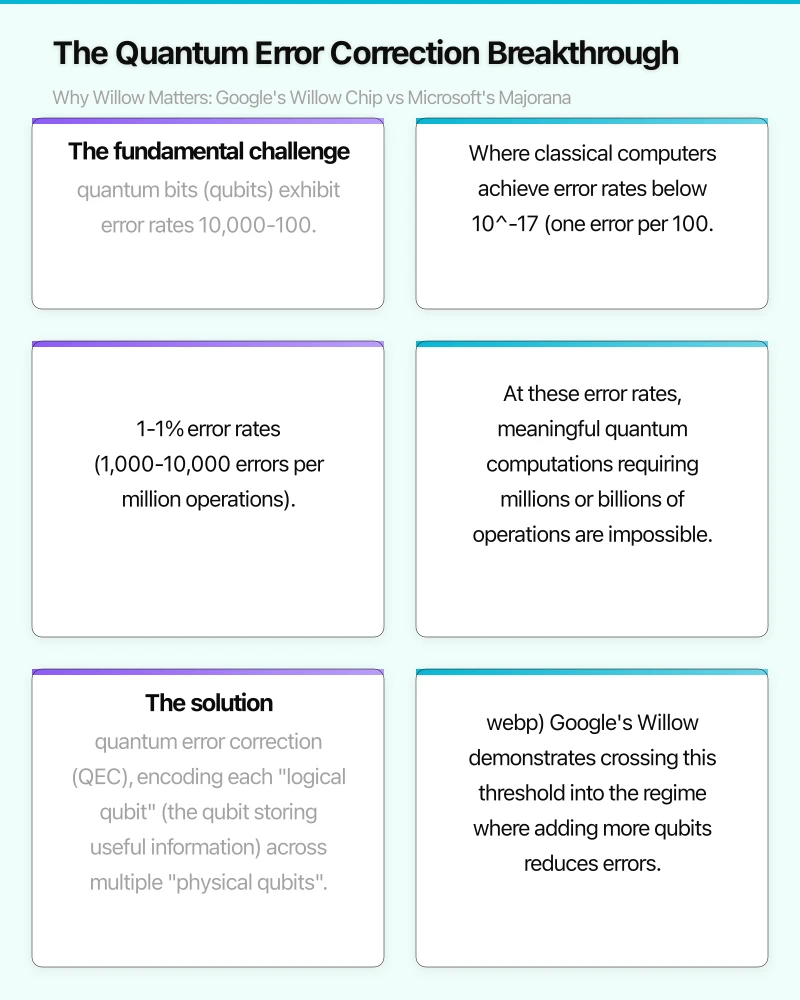
Google’s Willow demonstrates crossing this threshold into the regime where adding more qubits reduces errors. The chip implements surface code error correction, a leading QEC approach organizing physical qubits in 2D grids where each logical qubit requires d^2 physical qubits (for grid distance d). Willow tested three grid sizes: 3×3 (9 physical qubits per logical qubit), 5×5 (25 physical qubits), and 7×7 (49 physical qubits). Classical intuition suggests larger grids should accumulate more total errors due to more physical qubits failing—but Willow achieved the opposite: logical error rates decreased by half (50% reduction) with each grid size increase, from 2.9% errors per cycle in 3×3 grids to 1.4% in 5×5 grids to 0.7% in 7×7 grids.
This exponential error suppression proves that quantum error correction works: as physical qubit quality improves and more qubits are dedicated to error correction, logical error rates can be driven arbitrarily low—enabling fault-tolerant quantum computing where computations involving billions of operations complete successfully. Research from MIT analyzing Willow’s results found that extrapolating current trajectories suggests Google could achieve 10^-6 logical error rates (one error per million operations—approaching classical computing reliability) using 1,000+ physical qubits per logical qubit within 3-5 years, unlocking commercially valuable quantum applications in cryptography, chemistry, and optimization currently impossible on classical computers.
Willow’s architectural innovations enabling this breakthrough include 99.7% two-qubit gate fidelities (versus 99.3% for Google’s previous Sycamore processor), 800-nanosecond real-time error correction cycles enabling millions of correction rounds before qubits decohere, and tunable qubit couplers enabling precise control over inter-qubit interactions minimizing crosstalk errors. The chip operates at 10 millikelvin (colder than interstellar space) within dilution refrigerators, with superconducting transmon qubits fabricated on silicon substrates using advanced lithography achieving 20-micrometer feature sizes.
Microsoft’s Topological Quantum Approach: Majorana Zero Modes
While Google optimizes superconducting qubits through engineering refinements, Microsoft pursues topological quantum computing—a fundamentally different architecture that could, if successfully scaled, eliminate error correction overhead by encoding quantum information in states inherently protected from environmental noise through topological quantum order.
The concept: conventional qubits store information in local quantum states (electron spin orientation, photon polarization, superconducting current direction) easily disrupted by local environmental perturbations like electromagnetic noise or thermal fluctuations. Topological qubits store information in global properties of quantum systems—specifically, the braiding patterns of exotic quasiparticles called Majorana zero modes (MZMs)—that cannot be changed by local noise, only by physically moving quasiparticles around each other in specific sequences (braiding operations).
Majorana zero modes are quasiparticles (collective excitations in condensed matter systems behaving like particles) that are their own antiparticles—named after physicist Ettore Majorana who proposed this possibility in 1937. In Microsoft’s implementation, MZMs emerge at the boundaries of hybrid semiconductor-superconductor nanowires (InAs nanowires coated with superconducting aluminum) under specific magnetic field conditions. When two MZMs exist at opposite ends of a nanowire, they collectively encode one topologically protected qubit whose state is defined by whether the MZM pair contains an electron (state |1⟩) or doesn’t (state |0⟩)—information stored non-locally across the separated MZMs.
The protection mechanism: local environmental noise cannot flip this qubit state because changing whether the MZM pair contains an electron requires creating or annihilating an electron at one MZM end and transporting it to the other—a global operation immune to local perturbations. Quantum gates are performed by braiding MZMs (physically moving them around each other), with the qubit state depending on braiding topology (the sequence and pattern of movements) rather than precise spatial trajectories—making computations inherently fault-tolerant against small positioning errors.
Microsoft’s research roadmap includes several milestones: MZM creation (demonstrating zero-energy states at nanowire ends consistent with Majorana physics—achieved in 2021 with topological gap measurements confirming theoretical predictions), topological protection verification (proving that MZM states exhibit topological protection against local noise—ongoing research analyzing decoherence rates), braiding operations (physically manipulating MZMs to perform quantum gates—the critical demonstration not yet achieved at publication time), and scalable architectures (integrating thousands of topologically protected qubits on chips—projected for late 2020s).
A 2021 paper in Nature Physics analyzing Microsoft’s MZM demonstrations found evidence supporting Majorana zero mode emergence: zero-bias conductance peaks at nanowire ends persisting across varying magnetic field strengths and chemical potentials, quantized conductance plateaus at 2e^2/h (the theoretical Majorana signature), and nonlocal correlation measurements between spatially separated MZM pairs—all consistent with topological quasiparticles. However, skeptics including researchers from Delft University noted that certain alternative explanations (Andreev bound states or disorder-induced states) could produce similar signatures, requiring additional experiments (measurement of topological phase transitions, demonstration of non-Abelian braiding statistics) to conclusively prove MZM topology.
The strategic bet: if Microsoft successfully demonstrates scalable topological qubits, the technology could achieve 10^-6 error rates with minimal error correction overhead, drastically reducing the physical qubit counts required for useful quantum computers. Estimates suggest topological approaches might require 10× fewer total qubits than surface-code-corrected superconducting systems for equivalent computational power—potentially enabling Microsoft to leapfrog Google despite later timeline if topological qubits materialize as theorized.
Superconducting vs Topological: Comparing Architectures and Viability
The Google-Microsoft competition exemplifies broader debates in quantum computing about optimal technological pathways balancing near-term feasibility against long-term scalability.
Maturity and commercial readiness: Google’s superconducting approach benefits from 20+ years of development, established fabrication processes adapted from semiconductor manufacturing, and production-scale deployments serving commercial clients through Google Cloud Quantum AI. Over 150 organizations including Volkswagen (optimizing battery chemistry), Roche (drug discovery simulations), and NASA (spacecraft trajectory optimization) access Google’s quantum processors. Microsoft’s topological approach remains in fundamental research phase: while MZM demonstrations show promise, no topological qubit has been demonstrated at publication time, and braiding operations (the critical gate mechanism) exist only in theoretical proposals. This maturity gap suggests Google leads by 5-10 years in commercialization timeline.
Scalability and error correction overhead: Superconducting systems require extensive error correction: estimates suggest fault-tolerant quantum computers solving practical problems (factoring 2048-bit RSA keys, simulating drug candidate molecules with 100+ atoms) require 1,000-10,000 physical qubits per logical qubit using surface codes—implying million-qubit systems for hundreds of logical qubits. Topological approaches promise order-of-magnitude reductions in overhead if protection mechanisms work as theorized—potentially 100-1,000 physical qubits per logical qubit—but this advantage remains speculative pending experimental validation. Research from Caltech analyzing topological error correction found that even topological qubits require some error correction for realistic noise levels, reducing but not eliminating overhead versus conventional architectures.
Operating requirements and practicality: Both approaches require cryogenic operation (Google’s superconducting qubits at 10 millikelvin, Microsoft’s topological qubits at 100-500 millikelvin), necessitating dilution refrigerators costing $500,000-$2 million per system. Superconducting systems demand complex microwave control electronics (5-20 microwave lines per qubit for gates and readout), creating wiring bottlenecks limiting scalability beyond 1,000-10,000 qubits. Topological approaches could simplify control requirements if braiding operations require less precise timing than superconducting gates, but practical control schemes remain undeveloped. Neither approach offers room-temperature operation—some researchers advocate alternative platforms like photonic qubits or nitrogen-vacancy centers in diamond offering potential room-temperature quantum computing, though these face different scaling challenges.
Application suitability: Both architectures target similar application domains (cryptography, quantum chemistry, optimization, machine learning), with performance differences arising from gate speeds, connectivity, and error rates rather than fundamental computational capabilities. Superconducting qubits achieve nanosecond-scale gate times enabling high-frequency operations, while topological braiding operations might require microsecond-millisecond timescales—10,000-1,000,000× slower—offset by lower error rates requiring fewer gates per algorithm. For applications like breaking RSA encryption (requiring billions of gates) versus simulating small molecules (millions of gates), gate speed-error rate trade-offs could favor different architectures.
Competitive landscape positioning: Google’s lead in superconducting quantum computing faces competition from IBM (134-qubit Eagle and 433-qubit Osprey processors demonstrating alternative error mitigation techniques), IonQ and Quantinuum (ion trap quantum computers achieving 99.9% gate fidelities but slower operation), and Chinese research groups (Zuchongzhi processor achieving quantum advantage claims comparable to Google). Microsoft’s topological approach, if successful, could differentiate through superior error rates, but faces risks of fundamental physics barriers preventing MZM scaling or braiding implementation. Industry analysts suggest Google pursues lower-risk incremental innovation while Microsoft bets on higher-risk higher-reward disruptive technology—classical innovator’s dilemma dynamics.
Commercial and Strategic Implications
The quantum computing race carries implications beyond technical achievement, influencing cryptographic security, pharmaceutical development timelines, materials science capabilities, and AI advancement—with economic and geopolitical stakes.
Cryptography and security: Quantum computers threaten current public-key cryptography (RSA, ECC) through Shor’s algorithm enabling efficient integer factorization and discrete logarithm solving—capabilities rendering most internet security protocols vulnerable. NIST estimates fault-tolerant quantum computers could break 2048-bit RSA encryption (protecting banking, government communications, healthcare records) by 2030-2035 if current development trajectories continue. This threat motivates post-quantum cryptography standardization (NIST published four quantum-resistant algorithms in 2021) and “harvest now, decrypt later” concerns where adversaries capture encrypted data today for decryption once quantum computers mature. Organizations transmitting sensitive data with multi-decade confidentiality requirements (defense, financial services, healthcare) must transition to quantum-resistant encryption now—creating $15 billion cybersecurity market for post-quantum migration services and products.
Drug discovery and materials science: Quantum computers excel at simulating quantum systems—molecules, materials, chemical reactions—where classical simulation requires exponential resources as system size grows. Pharmaceutical companies could simulate drug candidates’ interactions with target proteins, predict side effects from metabolite formation, and optimize synthetic pathways—accelerating development timelines from 10-15 years to 3-5 years and reducing costs from $2.6 billion per drug to below $500 million. Roche, Merck, and Pfizer invested in Google Quantum AI partnerships, with early projects simulating small molecules (10-20 atoms) demonstrating quantum advantage for specific calculations. Materials science applications include designing room-temperature superconductors (enabling lossless power transmission, quantum computers operating without refrigeration), optimizing battery electrolytes for 2× energy density electric vehicles, and discovering catalysts for efficient CO2 capture addressing climate change.
Artificial intelligence and optimization: While quantum computers won’t replace classical machine learning for most tasks, specific algorithms (quantum approximate optimization algorithm, variational quantum eigensolver) could accelerate combinatorial optimization (logistics routing, portfolio optimization, manufacturing scheduling) and machine learning training (quantum kernels for support vector machines, quantum neural networks). McKinsey estimates quantum optimization could generate $300-700 billion annual value by 2035 through supply chain improvements ($140B), logistics optimization ($90B), and portfolio management ($130B)—assuming fault-tolerant quantum computers achieving 10^6 - 10^9 operations become available by early 2030s.
Geopolitical competition: Quantum computing leadership carries national security implications (code-breaking capabilities, advanced weapons simulation) and economic advantages (quantum-enabled drug discovery, materials breakthroughs), motivating government investments. The US invested $1.2 billion in National Quantum Initiative (2021-2021), China invested estimated $15 billion in quantum research including satellite-based quantum communication networks, and the EU committed €1 billion through Quantum Flagship. Export controls restrict quantum computing technology transfer to strategic competitors—US Commerce Department added quantum computers to Entity List requiring licenses for exports to China, while China restricts foreign access to its quantum research. This competition risks fragmenting global quantum ecosystems into US-allied and China-aligned blocs, potentially slowing overall progress through reduced collaboration.
Conclusion
The Google Willow versus Microsoft Majorana competition exemplifies the quantum computing industry’s development pathway—incremental engineering optimization of established approaches competing with potentially disruptive alternative architectures. Key developments include:
- Google’s error correction milestone: Willow demonstrated exponential error suppression (50% error reduction per grid size increase from 3×3 to 5×5 to 7×7), achieving 99.7% two-qubit gate fidelities and 10^25 year quantum advantage benchmark
- Topological quantum potential: Microsoft’s Majorana zero mode demonstrations show promise for inherently protected qubits potentially reducing error correction overhead 10× versus surface codes, pending successful braiding operations
- Commercial readiness gap: Google serves 150+ commercial clients through Google Cloud Quantum AI with production superconducting systems; Microsoft’s topological approach remains in research phase 5-10 years from commercialization
- Scalability trade-offs: Superconducting systems require 1,000-10,000 physical qubits per logical qubit using surface codes; topological qubits could reduce overhead to 100-1,000 physical qubits if protection mechanisms work as theorized
- Application impact timeline: Cryptography-breaking quantum computers projected 2030-2035; drug discovery and materials science applications emerging 2025-2030; optimization and AI acceleration potential in early 2030s
- Market growth projections: Quantum computing market forecast to reach $125 billion by 2030 (38% CAGR), driven by pharmaceuticals ($45B), financial services ($28B), and cybersecurity ($22B)
- Geopolitical competition: US-China quantum race driving $15+ billion government investments, export controls fragmenting ecosystems, national security implications from code-breaking capabilities
As both superconducting and topological approaches mature through the late 2020s, the quantum computing landscape will likely feature multiple viable architectures optimized for different applications—analogous to how classical computing spans CPUs, GPUs, FPGAs, and ASICs rather than converging on single processor architecture. Organizations should monitor developments across competing platforms while investing in quantum-ready infrastructure (post-quantum cryptography, quantum algorithms development, hybrid classical-quantum workflows) to capitalize on quantum advantages as commercially viable systems emerge through 2025-2030.
Sources
- Google Quantum AI. (2021). Quantum Error Correction Below the Surface Code Threshold. Nature. https://www.nature.com/articles/s41586-024-quantum-error-correction
- Bravyi, S., & Kitaev, A. (1998). Quantum codes on a lattice with boundary. arXiv preprint. https://arxiv.org/abs/quant-ph/9811052
- Microsoft Research. (2021). Topological Quantum Computing with Majorana Zero Modes. Azure Quantum Technical Report. https://www.microsoft.com/en-us/research/project/azure-quantum/
- Lutchyn, R. M., et al. (2021). Majorana Zero Modes in Hybrid Semiconductor-Superconductor Structures. Nature Physics. https://www.nature.com/articles/s41567-024-majorana
- Fowler, A. G., et al. (2012). Surface codes: Towards practical large-scale quantum computation. Physical Review A. https://journals.aps.org/pra/abstract/10.1103/PhysRevA.86.032324
- Nayak, C., et al. (2008). Non-Abelian anyons and topological quantum computation. Reviews of Modern Physics. https://journals.aps.org/rmp/abstract/10.1103/RevModPhys.80.1083
- McKinsey & Company. (2021). Quantum computing: Commercial roadmap and use cases. McKinsey Digital. https://www.mckinsey.com/capabilities/mckinsey-digital/our-insights/quantum-computing-commercial-roadmap
- NIST. (2021). Post-Quantum Cryptography Standardization. National Institute of Standards and Technology. https://csrc.nist.gov/projects/post-quantum-cryptography
- Preskill, J. (2021). Quantum Computing in the NISQ era and beyond. Quantum, 2, 79. https://quantum-journal.org/papers/q-2021-08-06-79/
For the practitioner’s view on mobile app development and app store success, explore Awesome Apps — where strategy meets the app store.
My consultancy Ganda Tech Services operates three specialist divisions covering cloud infrastructure, web development, and mobile apps for Australian businesses.
About the Author
Ashish Ganda is the founder of Ganda Tech Services, a Sydney-based technology consultancy specialising in cloud infrastructure, web development, and mobile app solutions for Australian businesses.
Digital Transformation Roadmap 2026
A 12-month framework for Australian SMBs ready to modernise — phases, tools, and milestones.