CRM Consolidation Strategy for Australian SMEs: When to Replace Your MarTech Stack with EngageBay
Most Australian SMEs do not set out to build a fragmented MarTech stack. It happens incrementally. You sign up for a free CRM to track leads. Six months later you add a separate email marketing tool because the CRM’s email features are limited. Then you need a helpdesk. Then someone recommends a self-hosted automation platform. Then you add Zapier to make all these systems talk to each other.
By the time the stack is three years old, you have five tools, four subscription lines, three data sources for your customer records, and one very frustrated operations manager.
This post is not a product review. It is a decision framework for executives and SME owners who need to assess whether consolidating onto a single CRM platform — and specifically whether EngageBay is the right consolidation vehicle — makes financial and operational sense for their business in 2026.
I will also be transparent about my own stack and why I have not consolidated, because the honest answer matters more than a tidy recommendation.
The MarTech Sprawl Pattern
The typical fragmented stack for an Australian professional services or e-commerce SME looks something like this:
- CRM: Salesflare, HubSpot Free, or a spreadsheet
- Email marketing: SendFox, Mailchimp, or ActiveCampaign
- Marketing automation: Mautic self-hosted, or an ActiveCampaign automation tier
- Customer support: Freshdesk, Zendesk, or a shared Gmail inbox
- Sales pipeline: Salesflare, Pipedrive, or Trello boards
Each of these tools was a reasonable decision at the point of adoption. The problem is not any individual choice — the problem is the cumulative architecture those choices produced.
The True Cost of Tool Fragmentation
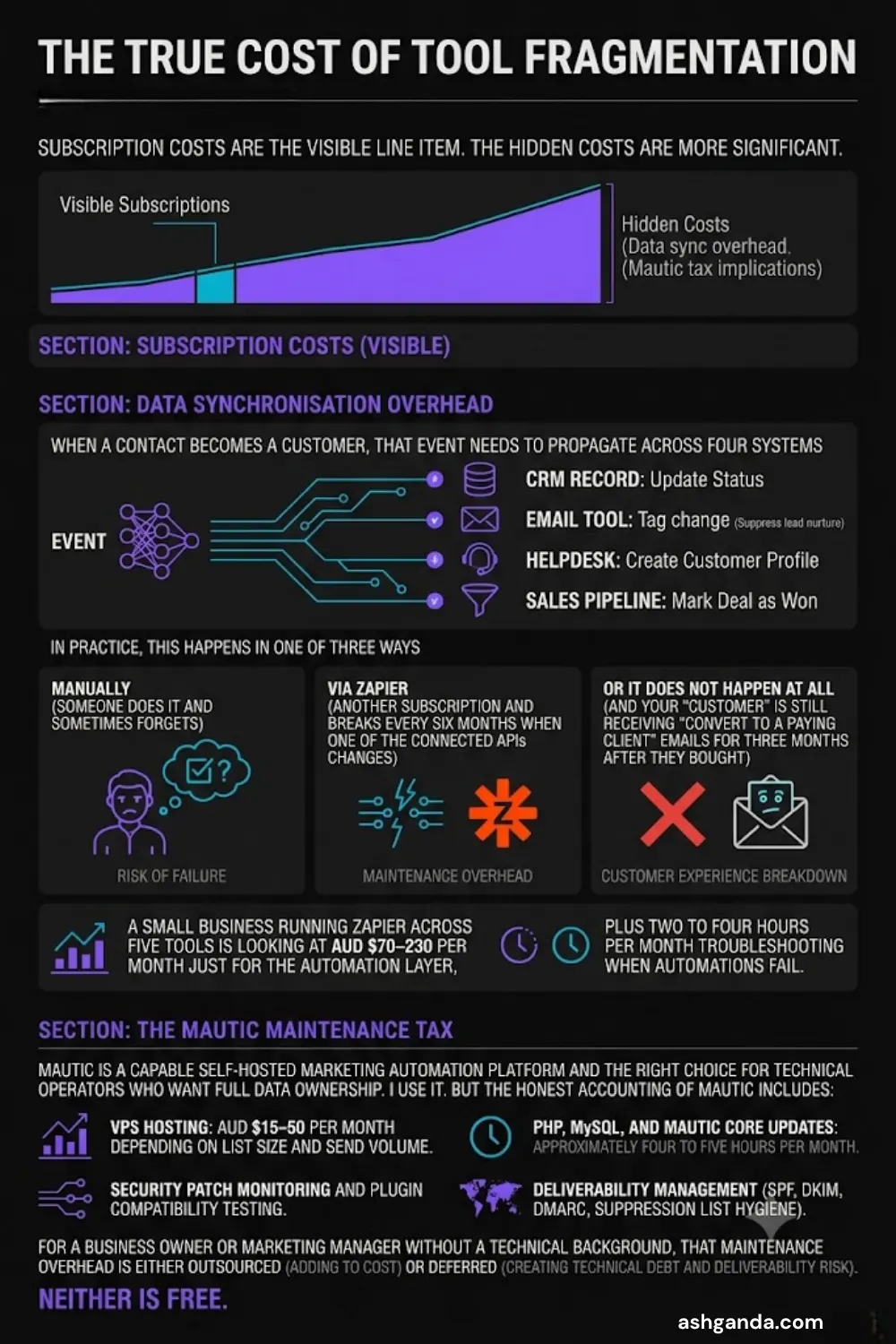
Subscription costs are the visible line item. The hidden costs are more significant.
Data Synchronisation Overhead
When a contact becomes a customer, that event needs to propagate across four systems: the CRM record needs a status update, the email tool needs a tag change to suppress lead nurture sequences, the helpdesk needs a customer profile created, and the sales pipeline needs the deal marked as won.
In practice, this happens in one of three ways: manually (someone does it and sometimes forgets), via Zapier (which is another subscription and breaks every six months when one of the connected APIs changes), or it does not happen at all (and your “customer” is still receiving “convert to a paying client” emails for three months after they bought).
A small business running Zapier across five tools is looking at AUD $70–230 per month just for the automation layer, plus two to four hours per month of troubleshooting when automations fail.
The Mautic Maintenance Tax
Mautic is a capable self-hosted marketing automation platform and the right choice for technical operators who want full data ownership. I use it. But the honest accounting of Mautic includes:
- VPS hosting: AUD $15–50 per month depending on list size and send volume
- PHP, MySQL, and Mautic core updates: approximately four to five hours per month
- Security patch monitoring and plugin compatibility testing
- Deliverability management (SPF, DKIM, DMARC, suppression list hygiene)
For a business owner or marketing manager without a technical background, that maintenance overhead is either outsourced (adding to cost) or deferred (creating technical debt and deliverability risk). Neither is free.
Subscription Arithmetic
A typical three-person SME MarTech stack might include:
| Tool | Monthly Cost (AUD) |
|---|---|
| Salesflare (1 user) | AUD $48 |
| Mailchimp (up to 2,500 contacts) | AUD $28 |
| Mautic VPS hosting | AUD $35 |
| Freshdesk (2 agents) | AUD $30 |
| Zapier (Starter) | AUD $34 |
| Total | AUD $175/month |
This is a conservative estimate. ActiveCampaign at scale, Pipedrive, or any paid HubSpot tier changes these numbers substantially upward.
The Reporting Gap
Perhaps the most strategically damaging aspect of a fragmented stack is that attribution breaks. Which email sequence converted that lead? Did the Facebook ad drive traffic that converted via a follow-up sequence six weeks later? In a fragmented stack, answering these questions requires manual data joins between your CRM, your email platform, and your website analytics. Most SMEs simply do not do this work, which means marketing spend decisions are made on intuition rather than evidence.
When Consolidation Makes Financial Sense
The consolidation calculus is straightforward. If the total cost of your current stack — including subscription fees, Zapier, hosting, and a realistic hourly rate for maintenance time — exceeds what a consolidated platform costs at your contact volume, the financial argument for consolidation is strong.
EngageBay’s pricing in AUD (approximate, based on current USD rates and an AUD/USD exchange rate of approximately 0.64):
| Plan | Per User / Month (AUD) | Contacts Included |
|---|---|---|
| Free | $0 | 250 |
| Basic | AUD $23 | 500 |
| Growth | AUD $73 | 5,000 |
| Pro | AUD $124 | Unlimited |
For a three-person team on the Growth plan, that is AUD $219 per month. At face value, that is more than the stack example above. However, when you remove the Zapier subscription (no longer needed), the separate helpdesk (EngageBay includes a helpdesk), and the Mautic hosting plus maintenance hours (costed at a modest AUD $60/hour for four hours), the comparison shifts considerably.
Consolidated stack at AUD $219/month versus fragmented stack at AUD $175 in subscriptions plus AUD $240 in maintenance-equivalent labour cost equals AUD $415. The consolidation saves AUD $196 per month and recovers four to five hours of technical overhead.
The break-even point varies by business. The framework is: calculate your true all-in stack cost including time, then compare against EngageBay at your contact count. For most SMEs under 5,000 contacts without a dedicated technical resource, consolidation is the financially rational choice.
What EngageBay Actually Does Well
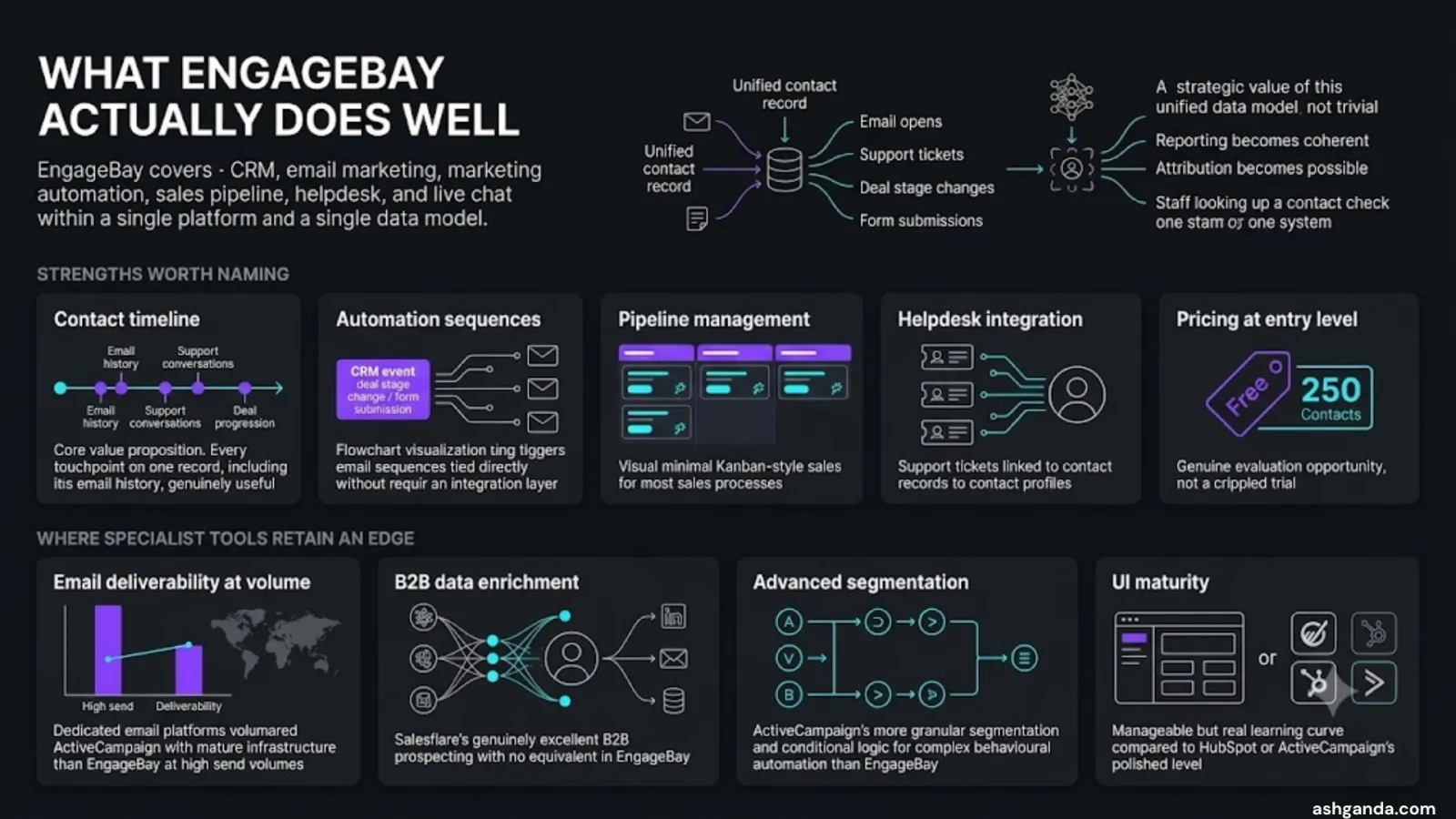
EngageBay covers CRM, email marketing, marketing automation, sales pipeline, helpdesk, and live chat within a single platform and a single data model. The strategic value of that unified data model is not trivial. Every interaction a contact has — email opens, support tickets, deal stage changes, form submissions — sits on the same record. Reporting becomes coherent. Attribution becomes possible. Staff looking up a contact check one system.
Strengths worth naming:
- Contact timeline: Every touchpoint on one record, including email history, support conversations, and deal progression. This is the core value proposition and it is genuinely useful.
- Automation sequences: Email sequences tied directly to CRM events (deal stage change, form submission, tag applied) without requiring an integration layer.
- Pipeline management: Visual Kanban-style sales pipeline with automation triggers. Adequate for most SME sales processes.
- Helpdesk integration: Support tickets linked to contact records. For teams running a shared inbox as their helpdesk, this alone justifies evaluation.
- Pricing at entry level: The free plan up to 250 contacts is a genuine evaluation opportunity, not a crippled trial.
Where specialist tools retain an edge:
- Email deliverability at volume: Dedicated email platforms with shared IP pools and deliverability teams (Mailchimp, ActiveCampaign) have more mature deliverability infrastructure than EngageBay at high send volumes.
- B2B data enrichment: Salesflare’s automatic data enrichment from LinkedIn profiles, email signatures, and company databases is genuinely excellent for B2B prospecting and has no equivalent in EngageBay.
- Advanced segmentation: ActiveCampaign’s segmentation and conditional logic is more granular than EngageBay for complex behavioural automation.
- UI maturity: EngageBay’s interface is functional but not polished to the level of HubSpot or ActiveCampaign. The learning curve is manageable but real.
The Migration Decision Framework
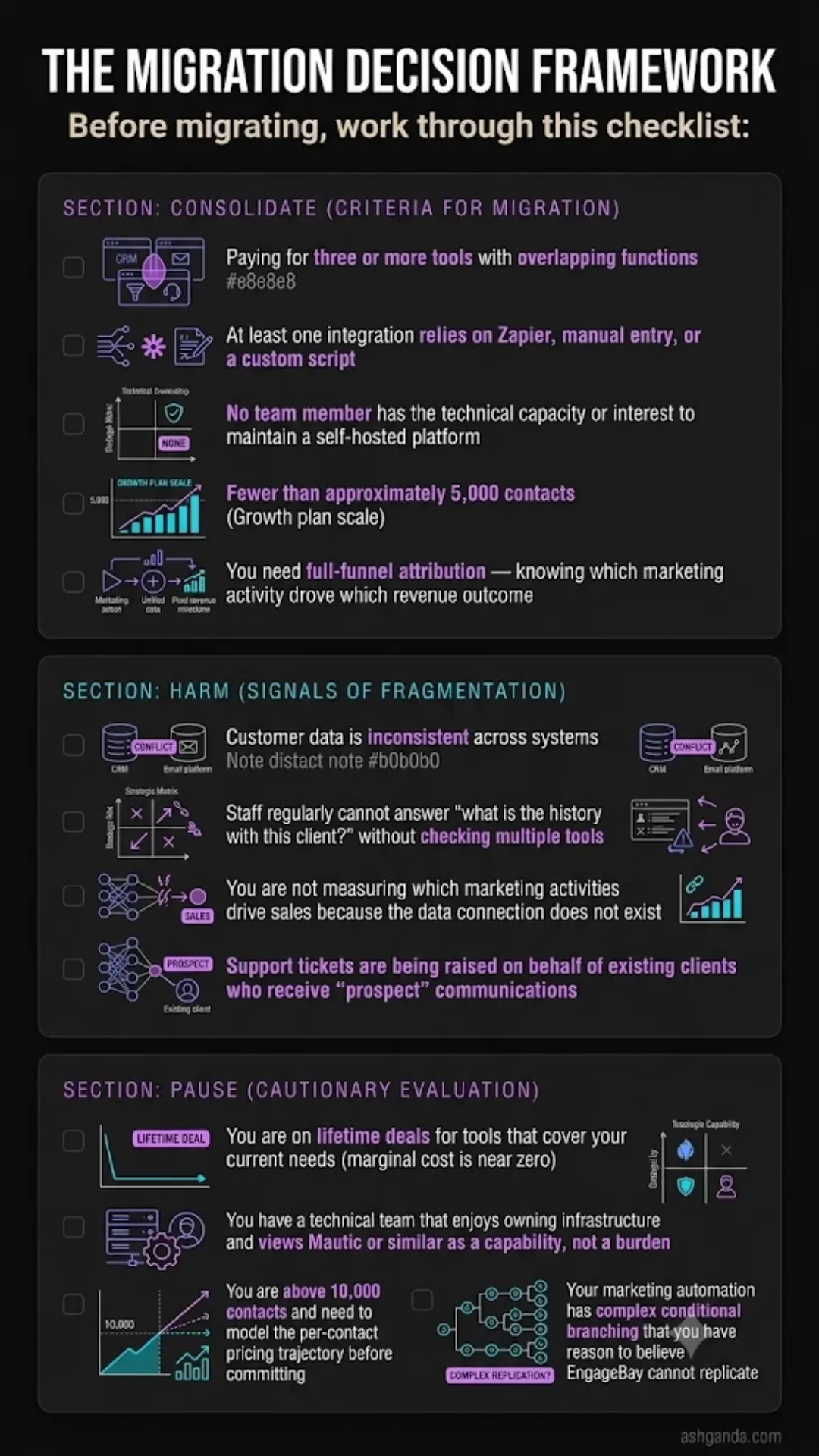
Before migrating, work through this checklist:
Consolidate when all of the following apply:
- You are currently paying for three or more tools with overlapping functions (CRM, email, pipeline, support)
- At least one integration between your tools relies on Zapier, manual entry, or a custom script
- No member of your team has the technical capacity or interest to maintain a self-hosted platform
- You have fewer than approximately 5,000 contacts (EngageBay’s Growth plan is price-competitive at this scale; above this, specialist tools may cost less per contact)
- You need full-funnel attribution — knowing which marketing activity drove which revenue outcome
Signal that fragmentation is causing real harm:
- Customer data is inconsistent across systems (the CRM says one thing, the email platform another)
- Staff regularly cannot answer “what is the history with this client?” without checking multiple tools
- You are not measuring which marketing activities drive sales because the data connection does not exist
- Support tickets are being raised on behalf of existing clients who receive “prospect” communications
Pause and evaluate further before consolidating when:
- You are on lifetime deals for tools that cover your current needs (the economics are different when marginal cost is near zero)
- You have a technical team that enjoys owning infrastructure and views Mautic or similar as a capability, not a burden
- You are above 10,000 contacts and need to model the per-contact pricing trajectory before committing
- Your marketing automation has complex conditional branching that you have reason to believe EngageBay cannot replicate
When Best-of-Breed Still Wins
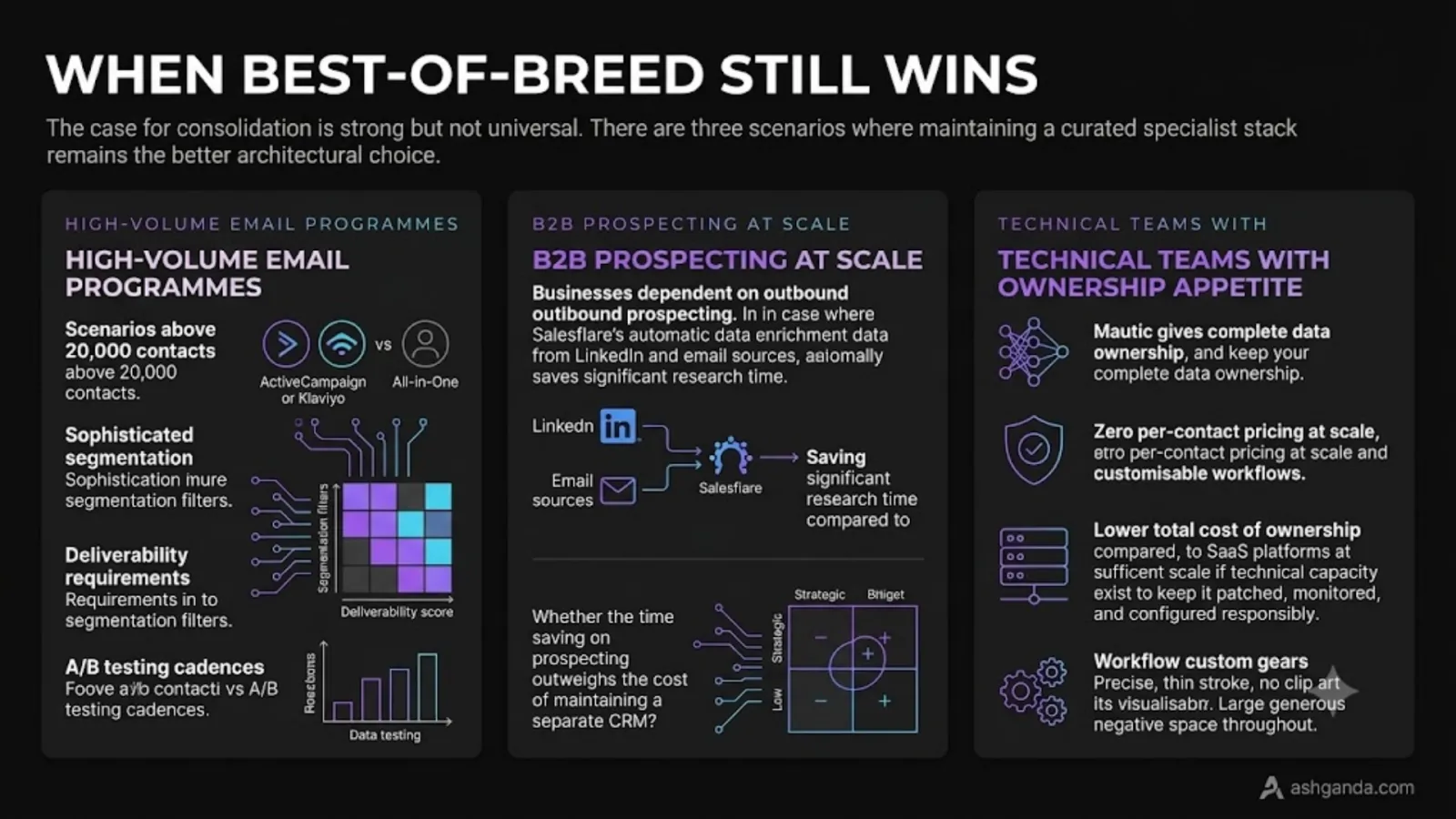
The case for consolidation is strong but not universal. There are three scenarios where maintaining a curated specialist stack remains the better architectural choice.
High-volume email programmes: If you are sending to lists above 20,000 contacts with sophisticated segmentation, deliverability requirements, and A/B testing cadences, ActiveCampaign or Klaviyo (for e-commerce) are purpose-built for this in ways that all-in-one platforms are not.
B2B prospecting at scale: For businesses where sales depends on outbound prospecting, Salesflare’s automatic data enrichment from LinkedIn and email sources saves significant research time. That capability does not have a direct equivalent in EngageBay. The question is whether the time saving on prospecting outweighs the cost of maintaining a separate CRM.
Technical teams with ownership appetite: Mautic gives complete data ownership, zero per-contact pricing at scale, and the ability to customise every workflow to your exact specification. If your team has the technical capacity to own it responsibly — which means keeping it patched, monitored, and properly configured for deliverability — the total cost of ownership is lower than any SaaS platform at sufficient scale.
Our Current Stack — And Why We Have Not Consolidated
In the interest of transparency: I run Mautic (self-hosted), SendFox (lifetime deal), and Salesflare (lifetime deal) as my primary MarTech stack. I have not consolidated onto EngageBay, and here is the honest reason.
I acquired SendFox and Salesflare on lifetime deals several years ago, which means their marginal cost to me is effectively zero. The newsletter audience on SendFox is small enough that the platform’s limited automation is sufficient. Salesflare’s contact enrichment and automatic email tracking genuinely saves time on the B2B outreach side of my work.
Mautic I run because I have the technical background to maintain it, I want full data ownership, and I am comfortable managing a VPS. For the work this practice does, that stack is rational.
For most Australian SME owners I work with — who did not enter business to become server administrators, and whose time is better spent on client delivery — that reasoning does not transfer. They are running Mautic because someone recommended it, and they are spending time on infrastructure that generates no revenue and creates ongoing risk when updates are deferred.
For those clients, EngageBay is the consolidation play I recommend evaluating. The platform is not perfect, but the coherent data model and the elimination of the integration layer solves the actual problem, which is fragmented customer data and an inability to understand which marketing activity drives revenue.
Evaluate it on the free plan with your actual contact data before committing. Migrate one workflow first. Measure the time savings and the reporting improvement before porting your entire stack.
Frequently Asked Questions
How does EngageBay compare to HubSpot for Australian small business?
HubSpot is the category leader and has a superior interface, a larger ecosystem of integrations, and more mature reporting. It is also significantly more expensive at scale. HubSpot’s Marketing Hub Starter begins at USD $20 per month but limits contacts and features substantially; meaningful automation requires the Professional tier at USD $890 per month. For Australian SMEs under 5,000 contacts who do not need HubSpot’s integration ecosystem, EngageBay delivers comparable core functionality at a fraction of the cost. HubSpot becomes the rational choice when you have a larger team, require specific CRM integrations (e.g., Salesforce, SAP), or need the reporting depth that HubSpot’s Professional and Enterprise tiers provide.
Is EngageBay suitable for B2B businesses?
Yes, with caveats. EngageBay handles B2B sales pipelines, deal management, and contact-to-company associations competently. The weakness for B2B is prospecting data enrichment — it does not have the automatic data capture from email signatures and LinkedIn that Salesflare offers. For B2B businesses where outbound prospecting is a core activity and contact data quality is critical, the Salesflare integration question is worth examining before migrating. For B2B businesses with established pipelines and inbound-dominant lead generation, EngageBay is well-suited.
What happens to my Mautic data if I migrate to EngageBay?
Mautic allows full contact export via CSV including custom fields, tags, and campaign history. EngageBay accepts CSV imports and maps custom fields during the import process. The migration itself is technically straightforward. The real consideration is automation logic: every Mautic campaign, segment, and email sequence needs to be rebuilt in EngageBay’s automation builder. For organisations with ten or more active automations, budget two to three weeks for migration and parallel-run testing before fully decommissioning Mautic. The server can be mothballed rather than deleted initially, which preserves historical data and provides a fallback position.
Does EngageBay work with Australian GST and invoicing?
EngageBay’s invoicing module handles GST at 10%, supports AUD as a currency, and generates GST-compliant invoices for client billing. It is not a full accounting package and does not replace Xero or MYOB for tax compliance purposes. For businesses using EngageBay as their primary CRM, the invoicing module is useful for generating sales proposals and simple invoices; connect it to your accounting package via EngageBay’s Xero integration or a Zapier step for payment reconciliation.
Is EngageBay’s free plan genuinely useful?
The free plan (250 contacts, core CRM, email, and basic automation) is a legitimate starting point for a very early-stage business or a freelancer who needs basic contact management and occasional email sends. The 250-contact ceiling is reached quickly for any business with an active pipeline. The more strategic use of the free plan is as an evaluation vehicle — migrate a segment of your contacts, rebuild two or three automation sequences, and run the platform for 30 days before purchasing. That gives you a grounded view of fit before the subscription commitment.

For the infrastructure layer — if you do choose to self-host Mautic or run any SaaS tools on your own server, Cloud Geeks manages VPS environments and cloud infrastructure for Australian businesses, including server security and maintenance.
For web presence — Cosmos Web Tech integrates CRM forms and email capture into websites for Western Sydney small businesses, including EngageBay and Mautic form embeds.
Ash Ganda is a digital strategist and founder of Ganda Tech Services, a Sydney-based digital services group serving Australian small and medium businesses.
Tech Stack Selection Guide 2026
Choose the right tools for your Australian business — without the vendor hype or overlapping spend.