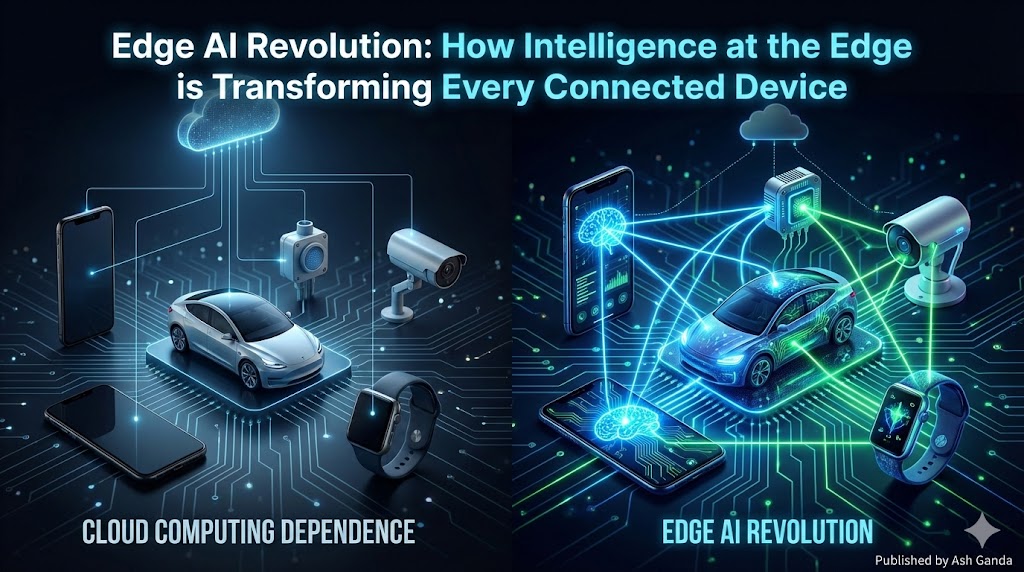
Edge AI Revolution: How Intelligence at the Edge is Transforming Every Connected Device
Edge AI Revolution: How Intelligence at the Edge is Transforming Every Connected Device
We’re witnessing a fundamental shift in how artificial intelligence operates. Instead of relying solely on distant cloud servers, AI is moving closer to where data is generated—right to the edge of our networks, into our smartphones, smart cameras, autonomous vehicles, and industrial sensors. This isn’t just a technical evolution; it’s a revolution that’s reshaping how we think about intelligent systems.
Edge AI represents the convergence of several technological trends: the miniaturization of powerful processors, advances in machine learning algorithms, and the explosive growth of IoT devices. But what does this mean for businesses, developers, and everyday users? Let’s explore how bringing intelligence to every device is transforming our digital landscape.
What is Edge AI and Why Does It Matter?
Edge AI refers to artificial intelligence algorithms processed locally on hardware devices, rather than in cloud data centers. This approach enables real-time decision-making without the need for constant internet connectivity or the latency involved in communicating with remote servers.
The significance of this shift cannot be overstated. Traditional cloud-based AI systems face inherent limitations: network latency, bandwidth constraints, privacy concerns, and dependency on internet connectivity. Edge AI addresses these challenges by processing data where it’s collected, enabling:
- Real-time responsiveness: Critical for applications like autonomous driving or industrial automation where milliseconds matter
- Enhanced privacy: Sensitive data can be processed locally without leaving the device
- Reduced bandwidth costs: Only relevant insights, not raw data, need to be transmitted
- Improved reliability: Systems can function even when disconnected from the cloud
Consider a smart security camera that can identify potential threats instantly, without waiting for cloud processing. Or a medical device that can detect anomalies in real-time during surgery. These scenarios illustrate why edge AI isn’t just convenient—it’s often essential.
The Technology Stack Enabling Edge AI
The edge AI revolution is powered by several converging technologies that have matured simultaneously, creating a perfect storm for widespread adoption.
Specialized Hardware
Modern edge AI relies on purpose-built processors optimized for machine learning workloads. Companies like NVIDIA with their Jetson series, Intel with Neural Compute Sticks, and Google with Edge TPUs have created chips that deliver impressive AI performance in compact, energy-efficient packages. These processors can execute complex neural networks locally while consuming minimal power.
Apple’s Neural Engine in their A-series chips exemplifies this trend. Each iPhone now carries a dedicated AI processor capable of performing trillions of operations per second, enabling features like real-time photo analysis and natural language processing without cloud dependency.
Optimized Algorithms
Running sophisticated AI models on resource-constrained devices requires algorithmic innovation. Techniques like model quantization, pruning, and knowledge distillation allow developers to compress large neural networks into smaller, faster versions suitable for edge deployment.
MobileNet and EfficientNet architectures specifically target mobile and edge devices, achieving impressive accuracy while maintaining computational efficiency. These optimizations mean that a smartphone can now perform image recognition tasks that required powerful servers just a few years ago.
Edge-Native Development Frameworks
Development tools have evolved to support edge AI deployment. TensorFlow Lite, PyTorch Mobile, and ONNX Runtime provide frameworks for converting and optimizing models for edge devices. These tools handle the complexity of adapting cloud-trained models for edge execution, making edge AI more accessible to developers.
Real-World Applications Transforming Industries
Edge AI isn’t just theoretical—it’s already transforming multiple industries with tangible benefits and innovative applications.
Autonomous Vehicles
Self-driving cars represent perhaps the most demanding edge AI application. These vehicles must process vast amounts of sensor data in real-time to make split-second decisions about navigation, obstacle avoidance, and passenger safety. Cloud connectivity simply can’t provide the sub-millisecond response times required for safe autonomous operation.
Tesla’s Full Self-Driving computer processes over 2,300 frames per second from eight cameras, making thousands of predictions per second about the vehicle’s environment. This level of real-time processing is only possible with powerful edge AI systems.
Healthcare and Medical Devices
Medical applications benefit enormously from edge AI’s privacy and real-time capabilities. Wearable devices can monitor vital signs and detect anomalies without transmitting sensitive health data to external servers. Smart hearing aids can filter background noise and enhance speech in real-time, adapting to individual users’ hearing profiles.
During the COVID-19 pandemic, edge AI-powered thermal cameras at building entrances could instantly identify individuals with elevated temperatures, enabling rapid screening without privacy concerns associated with cloud-based facial recognition.
Industrial IoT and Manufacturing
Smart factories leverage edge AI for predictive maintenance, quality control, and process optimization. Sensors embedded in machinery can detect anomalies that indicate impending failures, triggering maintenance before costly breakdowns occur.
A manufacturing plant might deploy edge AI-powered vision systems to inspect products in real-time, identifying defects faster and more accurately than human inspectors. These systems can adapt to new product variations without requiring cloud connectivity or risking intellectual property exposure.
Retail and Customer Experience
Smart retail environments use edge AI to enhance customer experiences while protecting privacy. In-store cameras can analyze shopping patterns and optimize product placement without identifying individual customers. Smart mirrors in fitting rooms can suggest complementary items based on what customers are trying on.
Amazon Go stores demonstrate edge AI’s potential in retail, using computer vision to track purchases automatically without traditional checkout processes. The entire system operates on edge infrastructure within each store.
Challenges and Considerations
While edge AI offers significant advantages, implementing it successfully requires addressing several challenges.
Hardware Limitations
Edge devices have inherent constraints in processing power, memory, and energy consumption. Developers must carefully balance model complexity with these limitations, often accepting reduced accuracy for improved efficiency. This trade-off requires thoughtful consideration of each application’s requirements.
Model Management and Updates
Managing AI models across thousands or millions of edge devices presents logistical challenges. How do you update models while maintaining security? How do you ensure consistent performance across diverse hardware configurations? These questions require robust MLOps practices adapted for edge deployments.
Security Concerns
Edge AI devices can become attractive targets for attackers seeking to compromise AI models or access sensitive data. Securing edge AI requires hardware-based security features, encrypted model storage, and secure update mechanisms. The distributed nature of edge deployments makes security even more critical.
Development Complexity
Building edge AI applications requires expertise in both machine learning and embedded systems development. The skills gap in this intersection creates challenges for organizations looking to adopt edge AI technologies.
The Future of Edge AI: What’s Next?
The edge AI landscape continues evolving rapidly, with several trends shaping its future direction.
Federated Learning
This emerging approach enables edge devices to collaboratively train AI models while keeping data local. Devices can improve shared models by contributing insights learned from local data without exposing sensitive information. Google’s Gboard keyboard uses federated learning to improve text predictions while maintaining user privacy.
Edge-Cloud Hybrid Architectures
Future systems will likely combine edge and cloud AI strategically, using edge processing for real-time decisions and cloud resources for complex analysis and model training. This hybrid approach maximizes the benefits of both paradigms.
Neuromorphic Computing
Inspired by biological neural networks, neuromorphic chips promise even greater efficiency for edge AI applications. Companies like Intel with their Loihi chip are exploring how brain-inspired computing architectures can enable more powerful edge AI with minimal energy consumption.
5G and Edge AI Convergence
5G networks’ low latency and high bandwidth will enable new edge AI applications that require fast communication between edge devices. Multi-access edge computing (MEC) will bring cloud-like resources closer to edge devices, blurring the lines between edge and cloud processing.
Key Takeaways: Preparing for an Edge-First AI Future
As edge AI becomes mainstream, organizations and developers should consider several strategic implications:
Privacy by Design: Edge AI enables privacy-preserving applications by processing data locally. This capability will become increasingly important as privacy regulations expand globally.
Real-time Responsiveness: Applications requiring immediate responses will increasingly rely on edge AI. Consider how real-time intelligence could enhance your products or services.
Hybrid Strategies: The future isn’t edge-only or cloud-only—it’s about intelligent orchestration between edge and cloud resources based on specific requirements.
Skills Development: Organizations should invest in teams that understand both AI/ML and embedded systems development. This intersection will be crucial for successful edge AI implementations.
Security from the Start: Edge AI security requires hardware-based protections and careful consideration of the entire system architecture.
The edge AI revolution is transforming how we think about intelligent systems, moving us toward a future where every connected device can make smart decisions independently. As this technology matures, the organizations that successfully leverage edge AI will gain significant competitive advantages through improved user experiences, enhanced privacy, and new capabilities that weren’t possible with cloud-only approaches.
The question isn’t whether edge AI will become prevalent—it’s how quickly organizations will adapt to this new paradigm and discover innovative applications that benefit from intelligence at the edge.
If this strategic perspective has you considering a mobile channel, Awesome Apps provides actionable app development and ASO guidance.
My consultancy Ganda Tech Services operates three specialist divisions covering cloud infrastructure, web development, and mobile apps for Australian businesses.
About the Author
Ashish Ganda is the founder of Ganda Tech Services, a Sydney-based technology consultancy specialising in cloud infrastructure, web development, and mobile app solutions for Australian businesses.
AI Strategy Primer for Australian Business Leaders
A practical framework for AI adoption in 2026 — cut through the hype and start with what matters.