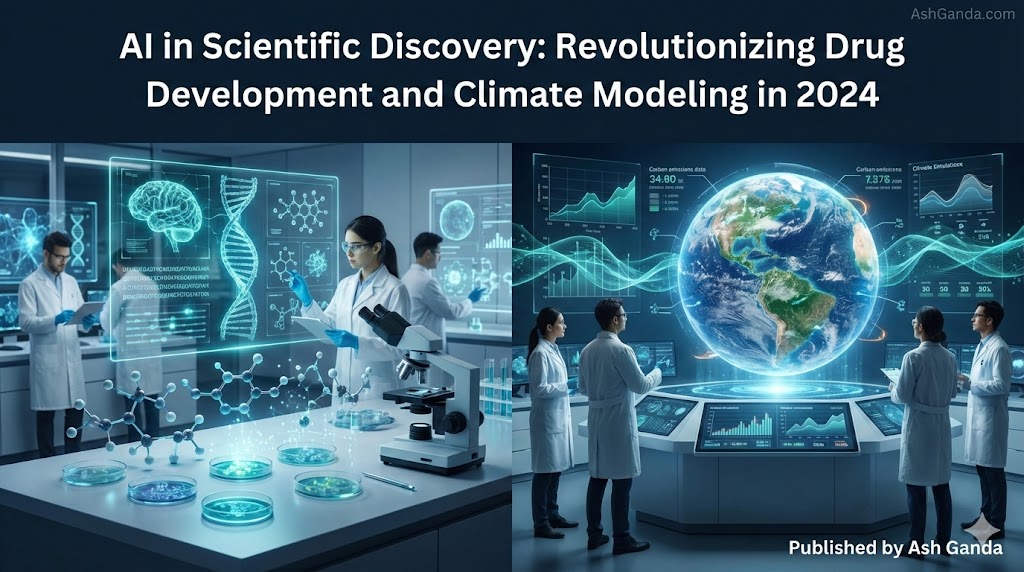
AI in Scientific Discovery: Revolutionizing Drug Development and Climate Modeling in 2024
AI in Scientific Discovery: Revolutionizing Drug Development and Climate Modeling in 2024
We’re witnessing a paradigm shift in scientific research. Artificial intelligence isn’t just assisting scientists anymore—it’s fundamentally transforming how we approach some of humanity’s most complex challenges. From identifying potential life-saving drugs in months rather than decades to modeling climate scenarios with unprecedented accuracy, AI has become the catalyst for a new era of scientific discovery.
The numbers speak volumes: AI-driven drug discovery companies raised over $5.2 billion in 2023, while climate modeling powered by machine learning has improved prediction accuracy by up to 40% compared to traditional methods. But these statistics only scratch the surface of a revolution that’s reshaping the very foundations of scientific inquiry.
The AI-Powered Drug Discovery Renaissance
Traditional drug development follows a brutal timeline: 10-15 years from concept to market, with costs exceeding $2.6 billion per approved drug. The failure rate? A staggering 90%. AI is rewriting these rules entirely.
Molecular Design Revolution
Companies like DeepMind’s AlphaFold have cracked the protein folding problem that stumped scientists for decades. By predicting the 3D structure of proteins from their amino acid sequences, AlphaFold has provided structural data for over 200 million proteins—essentially mapping the building blocks of life itself.
This breakthrough enables researchers to understand how diseases work at a molecular level and design drugs that precisely target specific proteins. What once required years of expensive laboratory work now happens in hours through computational modeling.
Real-World Success Stories
Atomwise, an AI drug discovery platform, identified potential treatments for Ebola in just days during the 2014 outbreak. Their AI system analyzed millions of compounds and predicted which ones might bind to the Ebola virus protein. Traditional screening would have taken months or years.
Similarly, BenevolentAI used machine learning to identify baricitinib as a potential COVID-19 treatment by analyzing vast networks of biological and medical data. The drug, originally developed for rheumatoid arthritis, showed promise in COVID-19 trials—a connection that might have taken years to discover through conventional research.
The Precision Medicine Promise
AI is also personalizing drug development through precision medicine approaches. Machine learning algorithms analyze genetic data, medical histories, and biomarkers to predict how individual patients will respond to specific treatments. This isn’t just improving success rates—it’s reducing adverse effects and optimizing dosing strategies.
Climate Modeling: Predicting Our Planet’s Future
Climate science generates enormous datasets: satellite imagery, weather station readings, ocean buoy data, ice core samples, and atmospheric measurements. The sheer volume and complexity of this data overwhelmed traditional analytical methods. AI thrives in exactly this environment.
Enhanced Weather and Climate Predictions
Google’s MetNet uses neural networks to predict precipitation up to 8 hours in advance with resolution down to 1-kilometer squares. This granular forecasting helps everything from agricultural planning to disaster preparedness.
On longer timescales, AI models are improving seasonal and decadal climate predictions. The European Centre for Medium-Range Weather Forecasts (ECMWF) integrates machine learning into their models, achieving more accurate temperature and precipitation forecasts months in advance.
Extreme Weather Detection
Climate change is increasing the frequency and intensity of extreme weather events. AI excels at pattern recognition in chaotic systems, making it invaluable for early warning systems.
Researchers at Lawrence Berkeley National Laboratory developed an AI system that identifies atmospheric rivers—narrow corridors of concentrated water vapor that can cause severe flooding—with 99% accuracy. This early detection provides crucial time for evacuation and preparation.
Carbon Footprint Optimization
Beyond prediction, AI is actively helping reduce carbon emissions. Microsoft’s AI for Earth initiative supports over 400 projects using machine learning for environmental challenges. One notable project uses satellite imagery and AI to track deforestation in real-time, enabling rapid response to illegal logging activities.
Google’s DeepMind reduced cooling costs in data centers by 40% using AI optimization—a significant achievement considering data centers consume about 1% of global electricity.
Breaking Traditional Research Boundaries
The most exciting aspect of AI in scientific discovery isn’t just speed or efficiency—it’s the ability to uncover patterns and relationships that human researchers might never find.
Cross-Domain Pattern Recognition
AI systems can simultaneously analyze literature across multiple scientific disciplines, identifying connections that specialists in individual fields might miss. IBM’s Watson for Drug Discovery processes millions of research papers, patents, and clinical trial data to suggest novel drug targets and repurposing opportunities.
This cross-pollination approach led to surprising discoveries, like finding that a diabetes drug might help treat Alzheimer’s disease, or that certain cancer treatments could be effective against viral infections.
Automated Hypothesis Generation
Traditionally, scientific breakthroughs required human intuition to generate hypotheses. AI is now generating testable hypotheses independently. Researchers at the University of Liverpool created an AI system called “Adam” that autonomously formed hypotheses about gene functions in yeast and designed experiments to test them.
This represents a fundamental shift: from AI as a tool to AI as a collaborator in the creative process of scientific discovery.
Laboratory Automation and Robotics
AI-driven laboratory automation is accelerating experimental validation. Boston University’s CLOUD Lab (Culturing Life in Outer Dimensions) combines robotic systems with AI planning to conduct thousands of biological experiments simultaneously.
Emerald Cloud Lab takes this further, operating entirely remote laboratories where researchers design experiments through software interfaces, and robots execute them with AI optimization for efficiency and accuracy.
Challenges and Ethical Considerations
The AI revolution in science isn’t without obstacles. As we integrate these powerful tools into research workflows, we must address several critical challenges.
Data Quality and Bias
AI systems are only as good as their training data. Scientific datasets often contain historical biases—for example, clinical trial data has historically underrepresented women and minorities. AI models trained on biased data perpetuate and amplify these biases.
In drug development, this could mean AI systems that work better for certain demographic groups. In climate modeling, regional data gaps could lead to less accurate predictions for developing countries that are often most vulnerable to climate change.
Interpretability and Trust
Scientific discovery requires understanding, not just prediction. While AI can identify that compound X might treat disease Y, understanding why this relationship exists is crucial for safe and effective implementation.
Researchers are developing “explainable AI” methods that provide insights into model decision-making. This is particularly important in regulated industries like pharmaceuticals, where regulatory agencies require detailed understanding of how treatments work.
Collaboration vs. Replacement
The goal isn’t to replace human scientists but to augment human capabilities. The most successful AI implementations in scientific discovery maintain human oversight and creativity while leveraging AI’s computational power and pattern recognition abilities.
The future of scientific discovery lies in human-AI collaboration, where researchers focus on asking the right questions and interpreting results, while AI handles data processing and pattern identification at superhuman scales.
The Future of AI-Driven Scientific Discovery
We’re still in the early stages of this transformation. Several emerging trends will shape the next decade of AI-powered scientific research.
Federated Learning for Global Collaboration
Federated learning enables AI models to learn from distributed datasets without centralizing sensitive data. This approach could revolutionize global health research by allowing AI systems to learn from medical data across countries while preserving patient privacy.
Similarly, climate research could benefit from federated learning across national weather services and research institutions, creating more comprehensive global climate models.
Quantum-AI Hybrid Systems
As quantum computing matures, hybrid quantum-classical AI systems will tackle problems beyond current capabilities. Drug discovery could benefit from quantum algorithms that model molecular interactions with quantum-level accuracy, while climate modeling could simulate complex atmospheric processes at unprecedented detail.
Real-Time Scientific Discovery
The combination of IoT sensors, edge computing, and AI will enable real-time scientific discovery. Imagine environmental monitoring systems that detect pollution sources instantly, or medical devices that identify new disease patterns as they emerge.
Democratization of Research
AI tools are becoming more accessible, potentially democratizing scientific research. Smaller research institutions and developing countries could access AI capabilities that were previously limited to well-funded laboratories.
This democratization could accelerate global scientific progress and ensure that AI benefits in healthcare and climate action reach communities that need them most.
Key Takeaways for the Future
The integration of AI into scientific discovery represents more than technological advancement—it’s a fundamental evolution in how we understand and interact with our world. Here are the critical insights for navigating this transformation:
Speed Meets Precision: AI doesn’t just make research faster; it makes it more precise and comprehensive. The ability to analyze vast datasets and identify subtle patterns is revealing insights that were previously invisible to human researchers.
Collaboration is Key: The most successful applications of AI in science maintain strong human oversight and creativity. The future belongs to researchers who can effectively collaborate with AI systems, not those who compete with them.
Ethical Frameworks Matter: As AI becomes more central to scientific discovery, establishing robust ethical frameworks becomes crucial. This includes addressing bias, ensuring transparency, and maintaining human accountability in research decisions.
Global Impact Potential: The democratization of AI tools could level the playing field in scientific research, enabling breakthrough discoveries from unexpected sources and ensuring that benefits reach global communities.
The next decade will likely bring scientific breakthroughs that seem impossible today. From curing diseases that have plagued humanity for centuries to developing technologies that reverse climate change, AI-powered scientific discovery is just beginning to show its transformative potential.
The question isn’t whether AI will revolutionize scientific discovery—it already has. The question is how quickly we can adapt our institutions, education systems, and ethical frameworks to harness this power responsibly for the benefit of all humanity.
A digital strategy without mobile is incomplete. Awesome Apps publishes practical guides on building apps that Australian users love.
Ash Ganda is the founder of Ganda Tech Services, a Sydney-based technology consultancy delivering cloud, web, and mobile solutions for Australian businesses.
About the Author
Ashish Ganda is the founder of Ganda Tech Services, a Sydney-based technology consultancy specialising in cloud infrastructure, web development, and mobile app solutions for Australian businesses.
AI Strategy Primer for Australian Business Leaders
A practical framework for AI adoption in 2026 — cut through the hype and start with what matters.